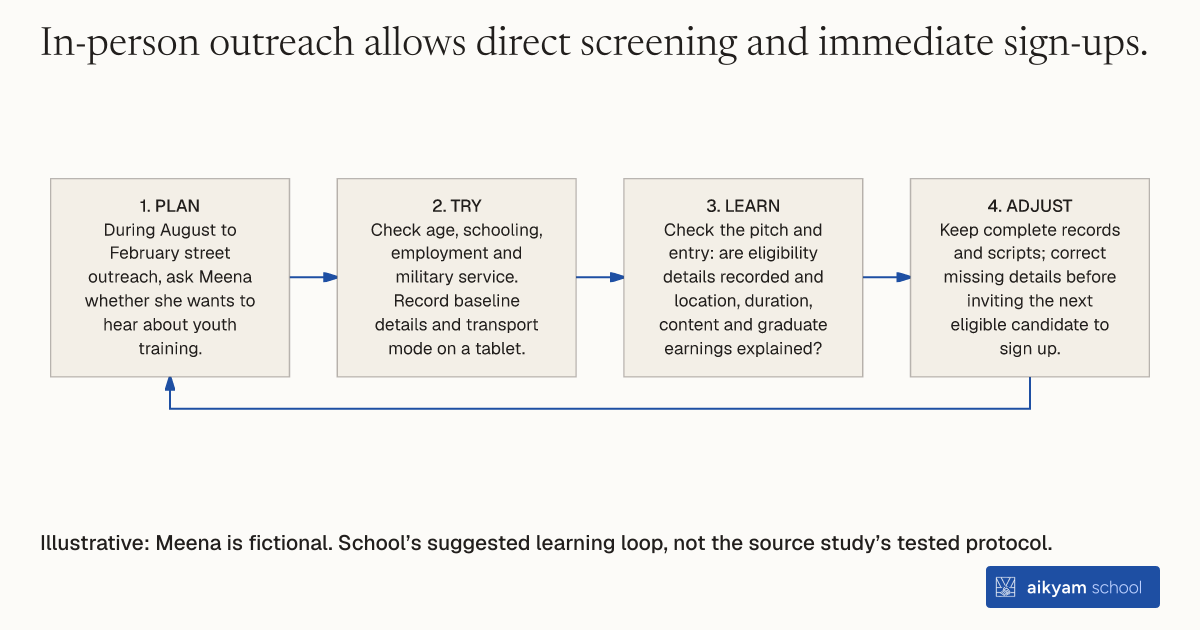
Try, learn and adjust
Check eligibility and recruitment information
- Plan: During August to February street outreach, ask Meena whether she wants to hear about youth training.
- Try: Check age, schooling, employment and military service. Record baseline details and transport mode on a tablet.
- Learn: Check the pitch and entry: are eligibility details recorded and location, duration, content and graduate earnings explained?
- Adjust: Keep complete records and scripts; correct missing details before inviting the next eligible candidate to sign up.
Illustrative: Meena is fictional. School’s suggested learning loop, not the source study’s tested protocol.
See source →School’s suggested learning loop, not a tested protocol. Observe eligibility records and delivery of the standard training pitch.
How
When to use
Job training programs often face low participation rates among unemployed youth. Program administrators need a direct outreach method to find, screen, and enroll candidates. This method works well when recruiting young adults in urban areas for entry-level vocational training.
Deploy trained surveyors in busy street areas to pitch job training directly to eligible young adults.
- Station surveyors in public urban spaces from August to February.
- Approach young adults in street locations and ask if they want to hear about youth job training opportunities.
- Assess candidate eligibility by asking about age, schooling, employment status, and military service.
- Record baseline characteristics and transport mode on surveyor tablets.
- Deliver a standardized script detailing class location, length, interactive content, and graduate average earnings.
- Invite eligible candidates to sign up for training on the spot.
Why it works
Personal conversations reduce information frictions and overcome hesitation better than passive advertisements.
Example
Surveyors in Cairo, Egypt approached 1,460 eligible youth aged 18 to 35 on city streets. The standard script provided details on a three to four week training program, resulting in a 43 percent baseline application rate.
About the study
Participants
1,460 eligible unemployed and underemployed youth aged 18 to 35 in Greater Cairo, Egypt.
Study Design
Individual-level randomized field experiment conducted on street locations using tablet-based randomization.
Results
The control pitch produced a 43 percent application rate, while overall treatment pitches produced small and statistically insignificant changes on average.