Research steps
Model adoption using reported beliefs and costs
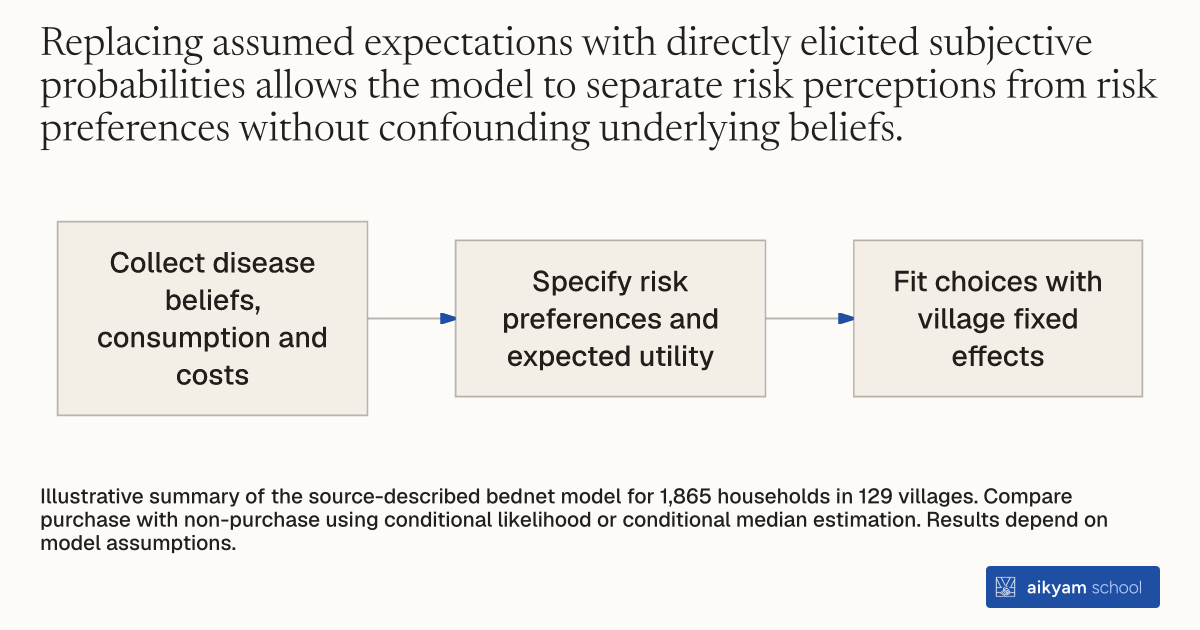
- Collect disease beliefs, consumption and costs
- Specify risk preferences and expected utility
- Fit choices with village fixed effects
Illustrative summary of the source-described bednet model for 1,865 households in 129 villages. Compare purchase with non-purchase using conditional likelihood or conditional median estimation. Results depend on model assumptions.
See source →How
When to use
Development economists and health planners need to understand why poor households fail to adopt preventive health technologies. Observed purchase choices alone cannot separate high purchase costs from low disease risk perceptions or low technology efficacy beliefs. Incorporating elicited subjective expectations into a structural discrete choice model isolates preference parameters, risk aversion, and belief drivers of technology adoption.
Estimate household risk preferences and technology purchase choices by combining elicited subjective probability beliefs with consumption data in a structural discrete choice framework.
- Elicit subjective probabilities of contracting disease under alternative technology adoption scenarios from survey respondents during household interviews.
- Collect household consumption levels across disease and adoption status combinations, subtracting purchase prices and illness treatment costs.
- Specify a constant relative risk aversion utility function where risk aversion parameters depend on household demographic covariates and disease status.
- Express the binary adoption choice as an expected utility comparison between purchasing and not purchasing the technology.
- Control for unobserved village-level environmental factors by incorporating cluster fixed effects into the choice specification.
- Estimate model parameters by maximizing a conditional likelihood function or conditional median objective function across sampled households.
Why it works
Allowing risk aversion to vary with household characteristics and disease status identifies non-linear preference parameters while controlling for unobserved local heterogeneity.
Example
Researchers modeled bednet purchase choices among 1,865 households across 129 villages in Orissa, India, using survey data from May–June 2007. Model estimates showed that households with more young children and older, more educated heads exhibited higher constant relative risk aversion. Perceptions of village-level net ownership significantly increased the direct utility of bednet adoption.
About the study
Participants
1,865 households across 129 villages in Bargarh, Balangir, Kandhamal, Keonjhar, and Sambalpur districts in Orissa, India, where over 90 percent of households belong to Scheduled Castes, Scheduled Tribes, or Other Backward Castes.
Study Design
Researchers estimated a structural discrete choice model of bednet adoption using conditional maximum likelihood with village fixed effects, combining elicited subjective expectations of malaria risk with itemized household expenditure data.
Results
Parameter estimates for risk aversion were positive and significant for household head education (point estimate 1.90, t-stat 4.01) and household head age (point estimate 1.80, t-stat 2.86), while perceived community net ownership above 50 percent directly increased adoption utility (point estimate 0.71, t-stat 5.24).