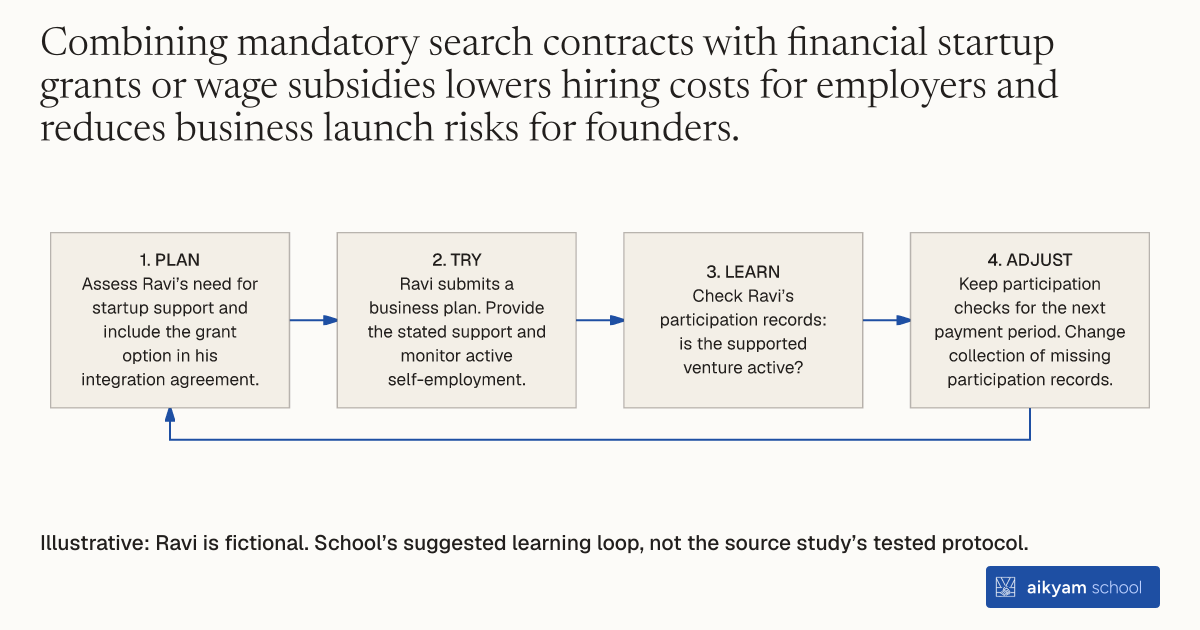
Try, learn and adjust
Check startup support and participation
- Plan: Assess Ravi’s need for startup support and include the grant option in his integration agreement.
- Try: Ravi submits a business plan. Provide the stated support and monitor active self-employment.
- Learn: Check Ravi’s participation records: is the supported venture active?
- Adjust: Keep participation checks for the next payment period. Change collection of missing participation records.
Illustrative: Ravi is fictional. School’s suggested learning loop, not the source study’s tested protocol.
See source →School’s suggested, untested loop. Observe the plan, support payments and participation. Startup support lasts up to 6 months plus up to 9 further months; no separate grant effect is established.
How
When to use
Unemployed job seekers facing labor market barriers may struggle to secure unsubsidized private sector jobs immediately. Focusing search obligations solely on regular jobs can prolong unemployment for workers needing initial financial support. Providing wage subsidies or startup grants creates immediate entry routes into active work and self-employment.
Offer wage subsidies or entrepreneurship startup grants within the framework of mandatory integration agreements to accelerate job re-entry.
- Evaluate whether a job seeker requires financial support to enter employment or start a business during integration agreement planning.
- Include wage subsidy provisions or business startup grant options in the written integration agreement.
- Require the job seeker to submit business plans or employer subsidy applications to the labor agency.
- Provide monthly subsidy payments matching unemployment benefits for up to six months, followed by fixed monthly allowances for up to nine additional months.
- Monitor ongoing participation in the subsidized job or self-employment venture to confirm active labor market re-entry.
Why it works
This incentivizes job seekers with lower employability to transition back into work sooner than they would through unsubsidized channels alone.
Example
In Germany, unemployed workers starting a business received a startup grant for up to 15 months. Across 2,475 low-employability participants in the trial, counting subsidized work and startup grants confirmed that early agreements increased one-year re-employment from 45% to 53%.
About the study
Participants
2,475 male UI benefit recipients with low employability (predicted median unemployment duration over 6 months) across five regional German agencies.
Study Design
Individual-level randomized controlled trial evaluating re-employment outcomes when including wage subsidies and startup grants lasting up to 15 months.
Results
Including subsidized employment and startup grants yielded consistent positive impacts for low-employability job seekers, maintaining an 8 percentage point increase in 1-year re-employment probabilities from 45% to 53%.