Try, learn and adjust
Check medicine vouchers are recorded at shops
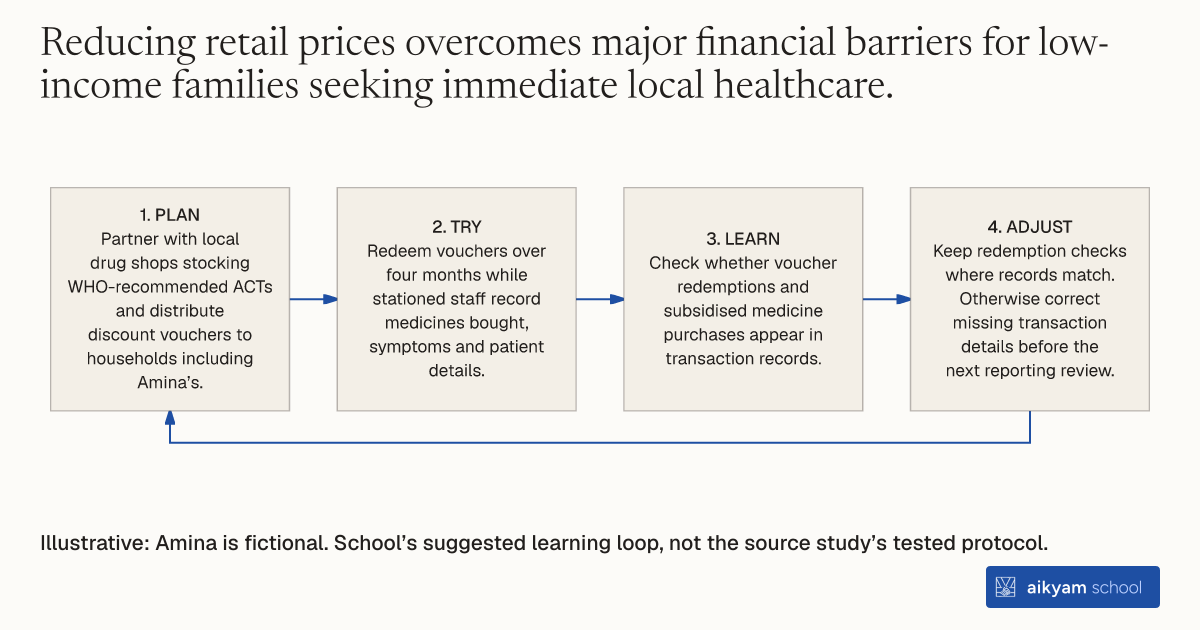
- Plan: Partner with local drug shops stocking WHO-recommended ACTs and distribute discount vouchers to households including Amina’s.
- Try: Redeem vouchers over four months while stationed staff record medicines bought, symptoms and patient details.
- Learn: Check whether voucher redemptions and subsidised medicine purchases appear in transaction records.
- Adjust: Keep redemption checks where records match. Otherwise correct missing transaction details before the next reporting review.
Illustrative: Amina is fictional. School’s suggested learning loop, not the source study’s tested protocol.
See source →School’s suggested, untested loop: observe vouchers and purchases at assigned subsidy levels of 80%, 88% or 92%. This loop does not change treatment decisions.
How
When to use
Rural populations in malaria-endemic regions often rely on local retail drug shops rather than distant public health clinics. High market prices make effective artemisinin combination therapies unaffordable for poor families. Subsidizing retail prices expands access to effective medication for vulnerable patients with suspected malaria.
Distribute discount vouchers to target households for purchasing artemisinin combination therapies at local retail drug shops.
- Program managers partner with local retail drug shops to stock WHO-recommended artemisinin combination therapies.
- Field staff distribute discount vouchers directly to target households to lower retail drug prices.
- Retail drug shops redeem customer vouchers for subsidized drug purchases over a four-month period.
- Stationed staff record transaction details, patient symptoms, and medication purchases at each shop.
Why it works
Lower costs enable patients who normally purchase cheap, ineffective antimalarials or skip treatment to obtain front-line therapies.
Example
In western Kenya, researchers distributed ACT vouchers to households near four rural drug shops between May and December 2009. The subsidy reduced retail costs by 80 to 92 percent, lowering medication prices from US$6.25 down to US$0.50–$1.25 per dose. Among the poorest households, ACT adoption for symptomatic children rose from 15 percent to 44 percent.
About the study
Participants
2,789 households living near four rural drug shops in a malaria-endemic area of western Kenya, with 38 percent of household heads illiterate.
Study Design
Randomized controlled trial conducted from May to December 2009 comparing an unsubsidized control group against three retail ACT subsidy levels (80%, 88%, and 92%). Trained staff logged drug transactions at shops, and endline surveys assessed household health outcomes four months post-distribution.
Results
Subsidizing ACTs decreased non-care seeking by 42 percent and increased retail shop care seeking by 32 percent. For illiterate-headed households, ACT use tripled from 11 percent to 38 percent. ACT coverage for sick children in the poorest households increased from 15 percent to 44 percent.