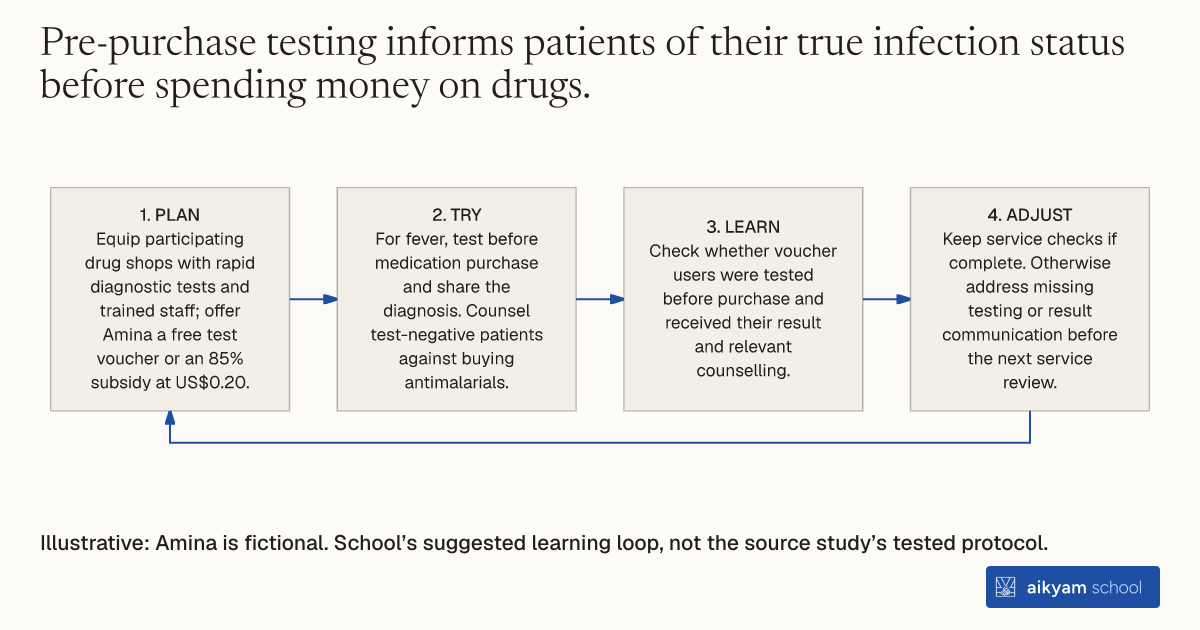
Try, learn and adjust
Check test vouchers lead to recorded diagnoses
- Plan: Equip participating drug shops with rapid diagnostic tests and trained staff; offer Amina a free test voucher or an 85% subsidy at US$0.20.
- Try: For fever, test before medication purchase and share the diagnosis. Counsel test-negative patients against buying antimalarials.
- Learn: Check whether voucher users were tested before purchase and received their result and relevant counselling.
- Adjust: Keep service checks if complete. Otherwise address missing testing or result communication before the next service review.
Illustrative: Amina is fictional. School’s suggested learning loop, not the source study’s tested protocol.
See source →School’s suggested, untested loop: observe test uptake, result communication and post-test purchases. This loop is not a clinical protocol.
How
When to use
Patients buying over-the-counter antimalarials at retail drug shops frequently self-diagnose without formal blood testing. Unconfirmed self-diagnosis causes widespread overtreatment, as only 25 percent of adults purchasing subsidized antimalarials actually have malaria. Subsidizing rapid diagnostic tests provides an affordable testing mechanism at local drug shops for fever patients and health programmers.
Offer subsidized rapid diagnostic test vouchers to households seeking malaria treatment at private retail drug shops.
- Program managers supply local retail drug shops with rapid diagnostic test kits and trained testing staff.
- Field staff distribute test vouchers to target households for free or at an 85 percent subsidy price of US$0.20 per test.
- Patients presenting with fever at participating drug shops present their test voucher to trained staff before buying medication.
- Trained staff administer the rapid diagnostic test on site and share the diagnosis within minutes.
- Patients who test negative receive counseling to forgo purchasing antimalarial medications.
Why it works
Knowing they lack malaria parasites leads most non-infected individuals to decline unnecessary artemisinin therapies.
Example
In western Kenya, researchers provided RDT vouchers (offered free or at an 85 percent subsidy for US$0.20) to households near four rural drug shops between May and December 2009. The intervention nearly doubled the share of malaria-like illness episodes that received diagnostic testing from 22 percent to 43 percent. Furthermore, 51 percent of patients over age 5 who tested negative chose not to purchase artemisinin combination therapy.
About the study
Participants
2,789 households residing near four rural drug shops in a malaria-endemic region of western Kenya, where 38 percent of household heads were illiterate.
Study Design
Randomized controlled trial conducted from May to December 2009 comparing a no-subsidy control group with groups receiving vouchers for rapid diagnostic tests (RDTs) either free or at an 85 percent subsidy (US$0.20), alongside subsidized ACTs. Trained staff posted at shops recorded transaction details, symptoms, test uptake, and post-test purchase choices.
Results
Offering RDT subsidies increased the proportion of illness episodes tested for malaria from 22 percent in the comparison group to 43 percent. Among patients over age 5 who received a negative test result, 51 percent chose not to purchase subsidized ACTs.