Research design
Combine outreach, reminders and rewards
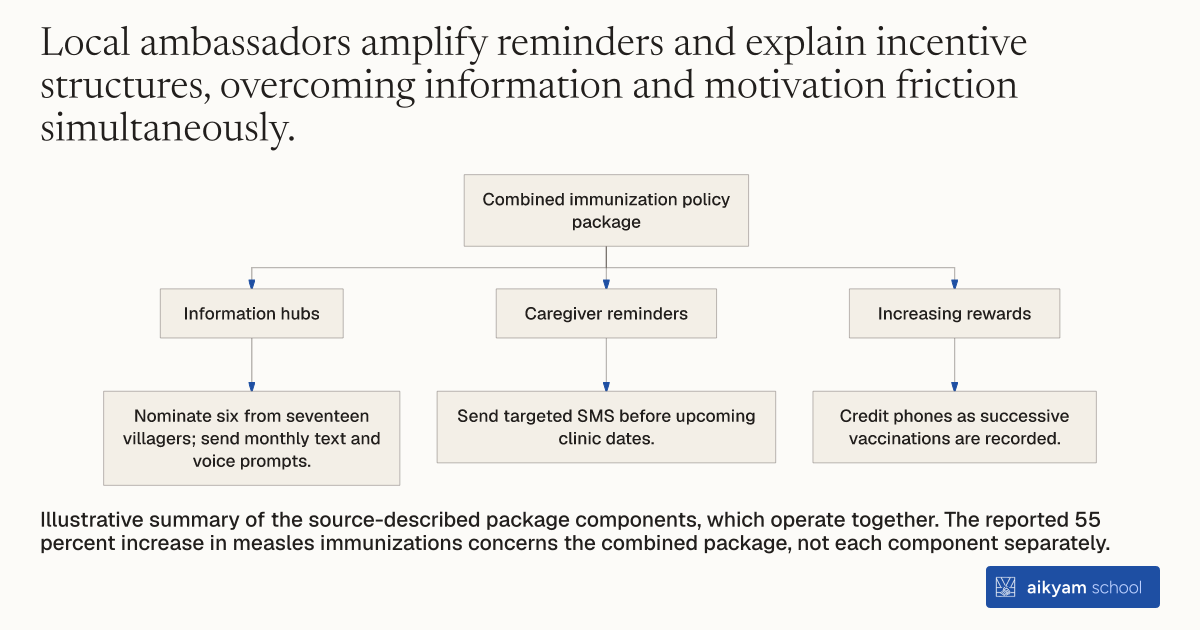
Combined immunization policy package
- Information hubs
- Nominate six from seventeen villagers; send monthly text and voice prompts.
- Caregiver reminders
- Send targeted SMS before upcoming clinic dates.
- Increasing rewards
- Credit phones as successive vaccinations are recorded.
Illustrative summary of the source-described package components, which operate together. The reported 55 percent increase in measles immunizations concerns the combined package, not each component separately.
See source →How
When to use
Single interventions like SMS reminders often fail on their own to overcome complex immunization barriers. Caregivers face cognitive, social, and financial frictions simultaneously across multi-dose vaccine schedules. Deploy this method to combine social network ambassadors, SMS reminders, and increasing monetary incentives into a unified policy bundle.
Combine community ambassadors, targeted SMS reminders, and increasing monetary incentives into a single policy package.
- Survey seventeen villagers to nominate six local information hubs as ambassadors.
- Send automated monthly text and voice reminders to ambassadors to encourage community outreach.
- Transmit targeted SMS reminders to registered caregivers prior to upcoming clinic dates.
- Distribute mobile phone credit incentives that increase in value across successive vaccine doses.
- Deploy the combined package across primary health centers to drive child immunization completion.
Why it works
The multi-tool synergy produces significantly larger increases in vaccination rates than any individual policy component alone.
Example
In 140 primary health centers in Haryana, India, combining information hub ambassadors, SMS reminders, and increasing incentives increased measles vaccination by 55 percent relative to the comparison group.
About the study
Participants
Caregivers and infants under twelve months of age across 140 primary health centers and 755 subcenters in Haryana, India.
Study Design
A randomized controlled trial cross-randomizing incentives, reminders, and ambassador selection strategies across 75 distinct policy packages.
Results
The full package increased measles immunizations per village per month from 7.32 in the comparison group to 11.34, representing a 55 percent increase.