Research steps
Weight invitations by recent bidding
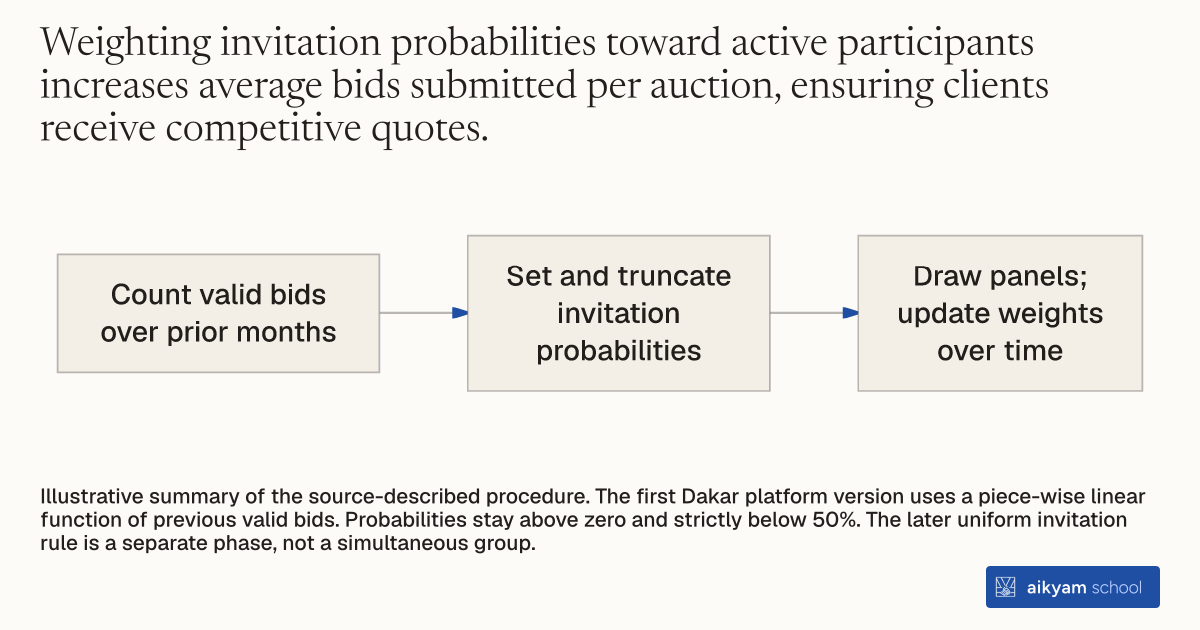
- Count valid bids over prior months
- Set and truncate invitation probabilities
- Draw panels; update weights over time
Illustrative summary of the source-described procedure. The first Dakar platform version uses a piece-wise linear function of previous valid bids. Probabilities stay above zero and strictly below 50%. The later uniform invitation rule is a separate phase, not a simultaneous group.
See source →How
When to use
Auction platforms need to maintain high active participation among decentralized service providers while ensuring non-participating operators still receive occasional job offers. The method addresses low bidder engagement by dynamically adjusting invitation frequencies based on recent provider bidding activity. It is designed for procurement managers and platform administrators running reverse auctions for urban utility or sanitation services.
Adjust auction invitation probabilities for service providers using a piece-wise linear function of their recent bidding frequency.
- Platform administrators track the number of valid bids submitted by each registered service provider over preceding months.
- The platform calculates individual provider invitation probabilities as a piece-wise linear function of past valid bid volume.
- Program managers apply lower and upper truncation thresholds so invitation probabilities remain bounded away from zero and strictly below 50%.
- The auction system generates randomized bidder panels for each new job request according to these adjusted probability weights.
- Administrators monitor provider response rates and update invitation weights periodically based on rolling participation records.
Why it works
Truncating probabilities prevents dominant firms from monopolizing job opportunities while guaranteeing inactive providers retain an incentive to re-engage.
Example
In the initial phase of the Dakar desludging auction platform, administrators invited vacuum truck operators using an invitation rule where probabilities varied as a piece-wise linear function of submitted bids in prior months, bounded away from zero and capped below 50%. This invitation design yielded an average panel size of 14 bidders and generated 2.35 valid bids per auction across 126 registered operators.
About the study
Participants
126 registered vacuum truck operators invited across peri-urban residential neighborhoods of Dakar, Senegal, participating in 2,825 auctions under the performance-weighted invitation rule (out of 5,331 total auctions).
Study Design
Randomized field trial platform evaluating performance-weighted dynamic invitation probabilities (piece-wise linear in past valid bids, bounded away from 0 and below 50%) with average invitation sizes of 14 bidders per auction.
Results
Weighting invitations by past activity yielded an average of 14 invited bidders per auction and achieved an active bidder participation rate of 23.5% among the 40 most active truckers, while subsequent uniform random invitations reduced average panel size from 14 to 11 bidders.