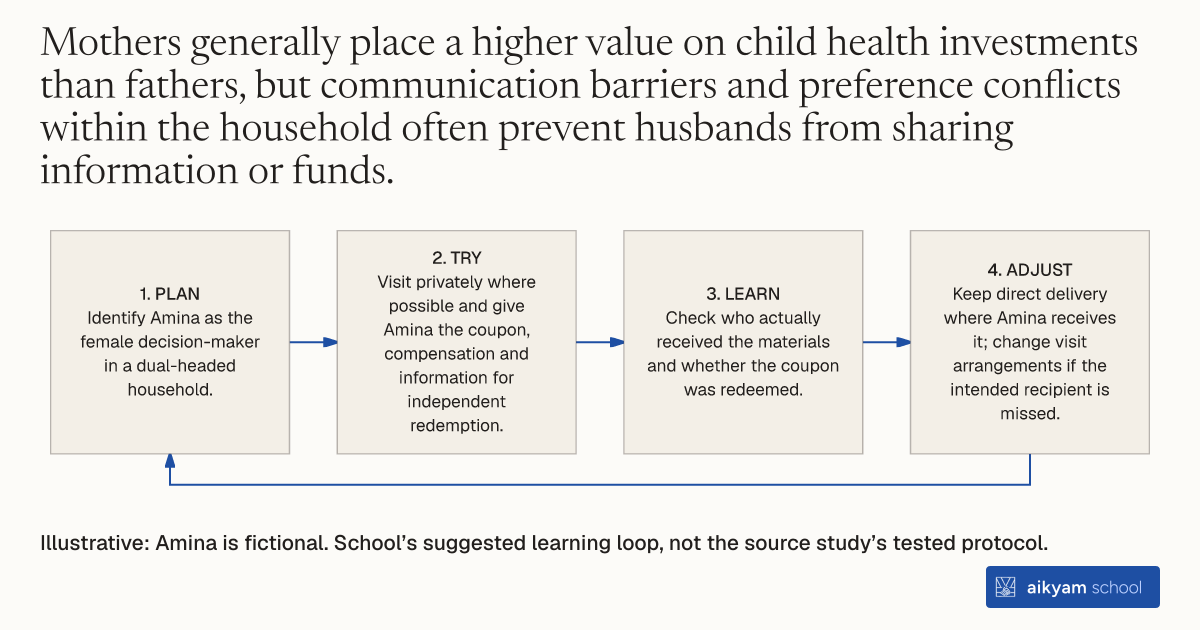
Try, learn and adjust
Check health coupons reach the intended woman
- Plan: Identify Amina as the female decision-maker in a dual-headed household.
- Try: Visit privately where possible and give Amina the coupon, compensation and information for independent redemption.
- Learn: Check who actually received the materials and whether the coupon was redeemed.
- Adjust: Keep direct delivery where Amina receives it; change visit arrangements if the intended recipient is missed.
Illustrative: Amina is fictional. School’s suggested learning loop, not the source study’s tested protocol.
See source →Observe intended and actual recipient and redemption; no individual purchase outcome is assumed. School suggests this learning loop; it was not tested by the source.
How
When to use
Within poor households in developing countries, mothers and fathers often disagree on spending priorities regarding preventative health products for children. Use this method when distributing discount vouchers or health interventions to ensure resources are directed to the parent most likely to invest in child health. It applies to programs providing subsidized health technologies to families in low-income rural communities.
Direct health product coupons, cash incentives, and program marketing directly to female household decision-makers rather than male heads.
- Identify dual-headed households during baseline demographic census surveys.
- Select the female parent or mother as the primary program contact for health intervention visits.
- Conduct household field visits privately with the selected female respondent whenever possible.
- Deliver discount vouchers, cash compensation, and health product information directly into the hands of the mother.
- Authorize the female recipient to redeem the voucher independently at participating local retail outlets.
Why it works
Directing coupons to women allows mothers to exercise spending agency without needing prior approval or financial transfers from their husbands.
Example
In dual-headed households in Western Kenya, field officers randomly assigned either the husband or wife to receive a discount coupon for children's shoes. When coupons were delivered to mothers rather than fathers, voucher redemption at local shops increased by 9 percentage points.
About the study
Participants
812 dual-headed households in Busia and Samia Districts of Western Kenya, living on roughly $1 per day with 3.5 children per family on average.
Study Design
Randomized controlled trial randomly offering discount coupons, cash payouts, and health scripts to either the husband or the wife, evaluated using OLS and instrumental variables (IV) estimation.
Results
Offering the coupon to the mother instead of the father increased purchase probability by 5 percentage points in OLS (p < 0.10) and by 9 percentage points in IV treatment-on-the-treated estimation (p < 0.10), equivalent to an 11% price reduction (9.5 Ksh).