Try, learn and adjust
Check the handover of community monitoring
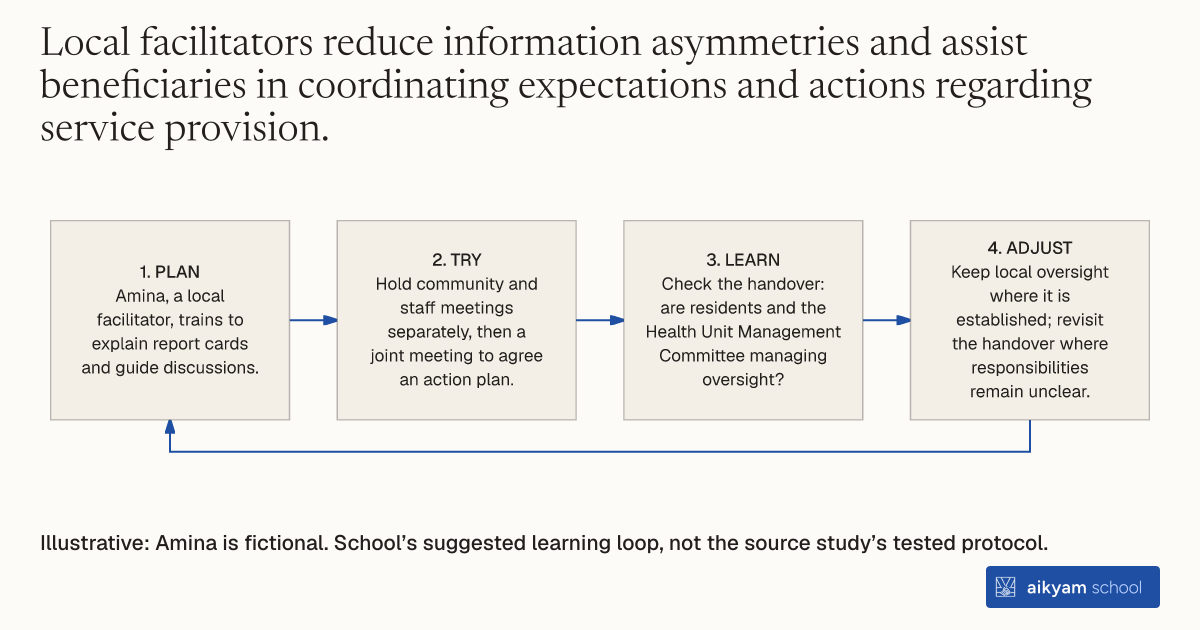
- Plan: Amina, a local facilitator, trains to explain report cards and guide discussions.
- Try: Hold community and staff meetings separately, then a joint meeting to agree an action plan.
- Learn: Check the handover: are residents and the Health Unit Management Committee managing oversight?
- Adjust: Keep local oversight where it is established; revisit the handover where responsibilities remain unclear.
Illustrative: Amina is fictional. School’s suggested learning loop, not the source study’s tested protocol.
See source →School’s suggested loop, not a tested source procedure. Observe meeting order, shared planning and transfer of monitoring responsibility.
How
When to use
Primary health care facilities in rural areas often suffer from poor service delivery, absenteeism, and weak accountability. Community monitoring programs require neutral local actors to guide citizens and health staff through participatory accountability processes. This method engages trained facilitators from local community-based organizations to initiate sustainable beneficiary oversight for primary health clinic users.
Contract and train facilitators from local community-based organizations to lead participatory monitoring meetings between citizens and health clinic staff.
- Project managers recruit facilitators from local community-based organizations operating within target primary health dispensary catchment areas.
- Project trainers instruct CBO facilitators on how to analyze baseline health report card data and moderate participatory discussions.
- CBO facilitators conduct an initial community meeting with local residents to discuss service delivery performance and rights.
- CBO facilitators host a separate staff meeting with primary health clinic workers to review facility indicators.
- CBO facilitators convene an interface meeting bringing together community members and health facility staff to negotiate a shared action plan.
- CBO facilitators hand over monitoring responsibility to local residents and Health Unit Management Committees to manage and sustain the oversight process.
Why it works
Using community-based organizations ensures that the monitoring process is locally managed and sustained without relying on permanent external enforcement.
Example
In a pilot project across 50 public dispensaries in 9 rural districts in Uganda, project managers deployed trained CBO facilitators to launch citizen monitoring. Facilitators conducted community, staff, and interface meetings, leading to an increase in post-treatment outpatient utilization from 661 patients per month in control clinics to 768 in treatment clinics, along with an increase in facility monthly deliveries from 9.2 to 15.5.
About the study
Participants
50 public primary health dispensaries and their corresponding catchment areas across 9 rural districts covering all four regions of Uganda.
Study Design
Randomized field experiment evaluating a community report card and facilitated meeting intervention, comparing 25 treatment health facilities with 25 control facilities.
Results
The intervention increased monthly outpatient visits by 107 patients over the control mean of 661 and monthly deliveries by 6.3 over the control mean of 9.2.