Try, learn and adjust
Check training before nightly reporting begins
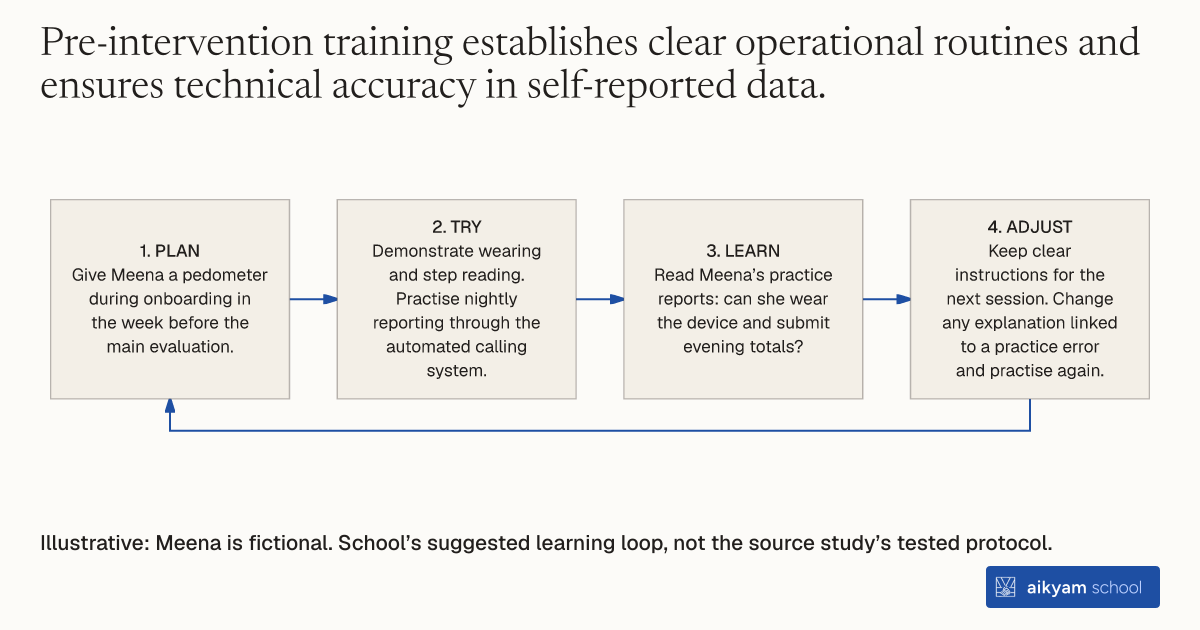
- Plan: Give Meena a pedometer during onboarding in the week before the main evaluation.
- Try: Demonstrate wearing and step reading. Practise nightly reporting through the automated calling system.
- Learn: Read Meena’s practice reports: can she wear the device and submit evening totals?
- Adjust: Keep clear instructions for the next session. Change any explanation linked to a practice error and practise again.
Illustrative: Meena is fictional. School’s suggested learning loop, not the source study’s tested protocol.
See source →School’s suggested, untested loop: observe device use and practice reporting; trial outcomes do not isolate training effects.
How
When to use
Health intervention programs requiring participants to track and report daily physical activity often fail due to improper device usage or reporting errors. Providing onboarding training ensures participants know how to operate tracking devices and submit daily activity logs. This method is used when launching health monitoring programs for urban populations managing chronic conditions like diabetes.
Train program participants on device operation and daily reporting protocols prior to beginning health interventions.
- Distribute pedometers to program participants during onboarding sessions.
- Demonstrate how to properly wear the pedometer during daily activities.
- Instruct participants on logging their total daily step counts every evening.
- Train participants on using an automated calling system to report steps nightly.
- Conduct practice reporting sessions during the week prior to the main evaluation.
Why it works
Establishing these habits before monitoring begins reduces participant non-compliance and technological friction during the intervention.
Example
Researchers trained nearly 3,200 urban diabetics and pre-diabetics in Tamil Nadu, India, one week before a twelve-week physical activity evaluation began. Participants learned how to properly wear pedometers and report steps nightly through an automated calling system.
About the study
Participants
3,192 urban diabetics and pre-diabetics in Tamil Nadu, India; average age almost 50 years; 58 percent male.
Study Design
Onboarding training delivered one week before a 12-week randomized controlled trial testing physical activity incentives.
Results
Following onboarding training, participants successfully logged step data daily, with incentive groups reaching step targets on 49 percent of days compared to 29 percent in monitoring-only groups.