Try, learn and adjust
Check self-reports against stored steps
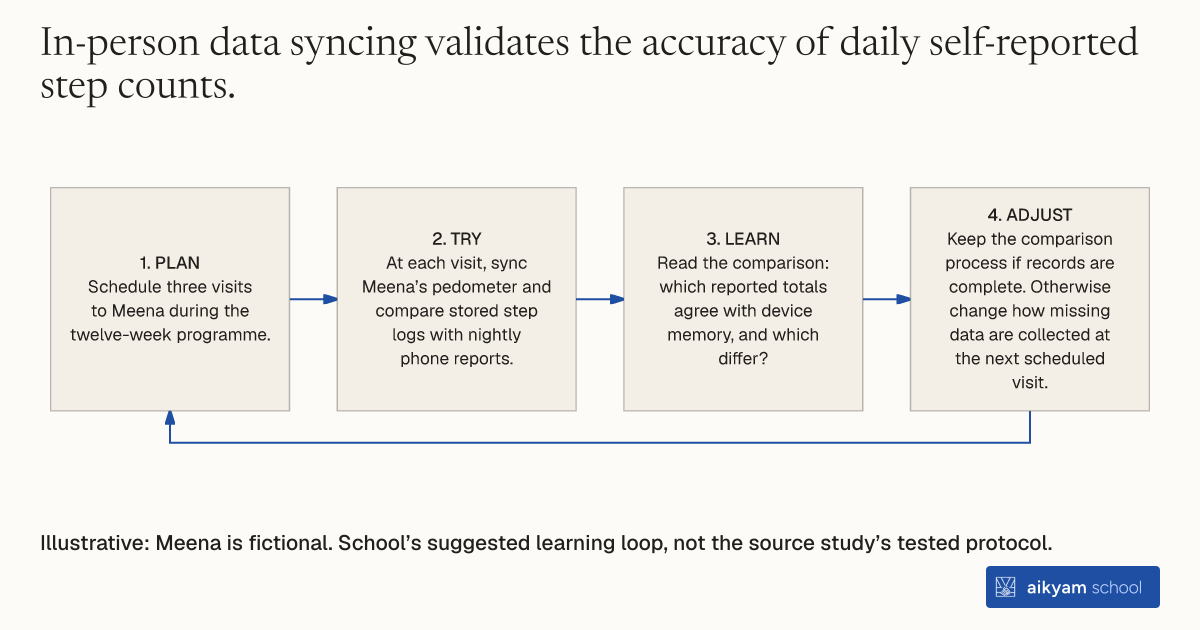
- Plan: Schedule three visits to Meena during the twelve-week programme.
- Try: At each visit, sync Meena’s pedometer and compare stored step logs with nightly phone reports.
- Learn: Read the comparison: which reported totals agree with device memory, and which differ?
- Adjust: Keep the comparison process if records are complete. Otherwise change how missing data are collected at the next scheduled visit.
Illustrative: Meena is fictional. School’s suggested learning loop, not the source study’s tested protocol.
See source →School’s suggested, untested loop: observe device logs and reported totals across the three visits; do not infer health effects.
How
When to use
Self-reported daily health data from mobile systems can suffer from misreporting or user error. Conducting periodic in-person verification visits ensures data integrity for activity tracking programs. This method is used when monitoring pedometer step counts among urban adults managing diabetes.
Conduct periodic in-person field visits to sync digital tracking devices and verify self-reported participant step data.
- Deploy field staff to visit participants at scheduled intervals during the monitoring program.
- Visit each participant three times across the twelve-week program duration.
- Access participants' pedometers during each in-person visit.
- Sync the physical pedometer devices to extract stored digital step logs.
- Cross-check synced pedometer data against daily self-reported step totals submitted via automated phone calls.
Why it works
Knowing that pedometers will be physically verified deters participants from misreporting their daily activity.
Example
In Tamil Nadu, India, researchers visited nearly 3,200 urban diabetics and pre-diabetics three times during a twelve-week physical activity evaluation. Staff synced participants' pedometers to verify step counts self-reported nightly through an automated calling system.
About the study
Participants
3,192 urban diabetics and pre-diabetics in Tamil Nadu, India; average age almost 50 years; 58 percent male.
Study Design
In-person pedometer verification visits conducted three times over a 12-week randomized controlled trial.
Results
Verified step data confirmed that incentive participants reached 10,000 steps on 49 percent of days compared to 29 percent for monitoring controls, adding 1,270 steps daily.