Research procedure
Separate project work from later jobs
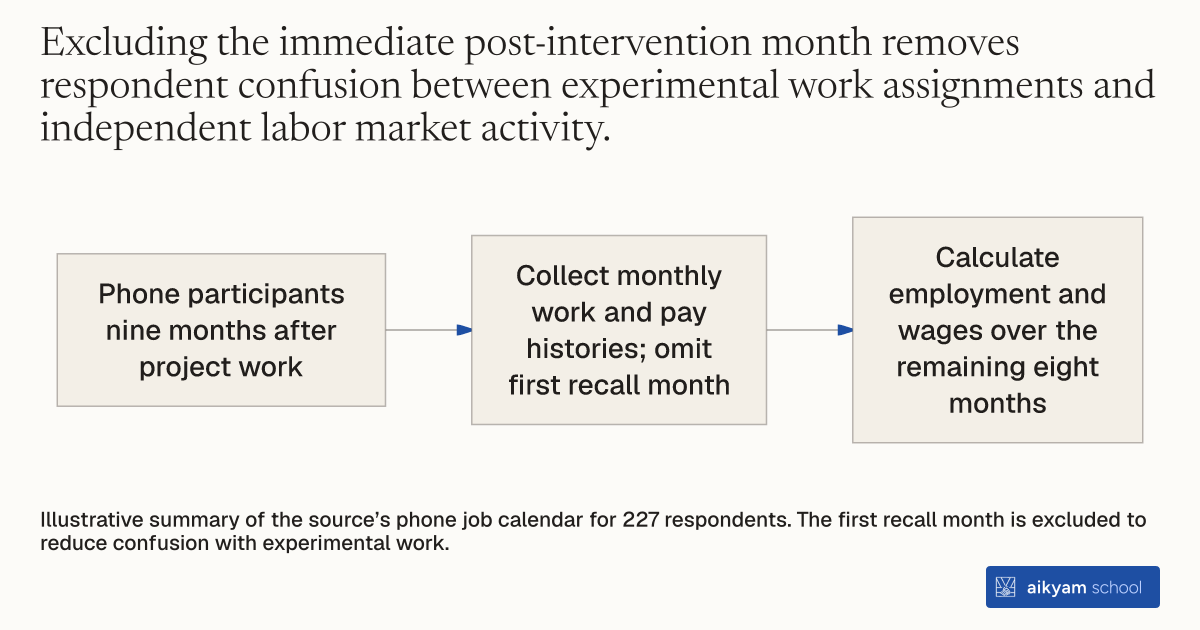
- Phone participants nine months after project work
- Collect monthly work and pay histories; omit first recall month
- Calculate employment and wages over the remaining eight months
Illustrative summary of the source’s phone job calendar for 227 respondents. The first recall month is excluded to reduce confusion with experimental work.
See source →How
When to use
In longitudinal employment evaluations, respondents often misreport short-term experimental project work as post-intervention employment during immediate follow-up interviews. Truncating survey recall periods by excluding the first post-project month eliminates recall errors where participants mix project tasks with independent employment. This method serves evaluators measuring long-term labor market outcomes among survey respondents.
Measure long-term labor market trajectories using phone-administered job calendar surveys with truncated recall windows.
- Contact study participants by phone 9 months after completing short-term work opportunities.
- Administer a retrospective month-by-month job calendar module covering employment activities, days worked per week, pay units, and daily earnings.
- Exclude the first month of recall data from outcome aggregations to remove survey recall error tied to experimental project work.
- Calculate post-intervention employment proportions, average days worked per week, and average daily wages across the remaining 8-month period.
Why it works
This ensures that calculated employment duration and wage averages reflect genuine independent labor market returns.
Example
A research team in Lilongwe, Malawi re-interviewed 227 male job seekers by phone 9 months after a recruitment experiment. The team collected retrospective job calendar data across 9 months but excluded the first month of recall data, analyzing independent labor market outcomes across the remaining 8 months.
About the study
Participants
227 urban male youth job seekers in Lilongwe, Malawi, interviewed at the 9-month follow-up out of 268 baseline participants (84.7% response rate).
Study Design
Phone-administered retrospective employment calendar survey covering 9 months, truncated to an 8-month analytical window to eliminate first-month recall error.
Results
Phone follow-up surveys tracked employment across the 8-month post-intervention period, finding that 5 days of short-term work experience increased average daily wages by $3.83 to $4.19 per day (p < 0.05) and increased employment duration by 6.8 to 8.8 percentage points.