Research procedure
Combine leader interviews and village audits
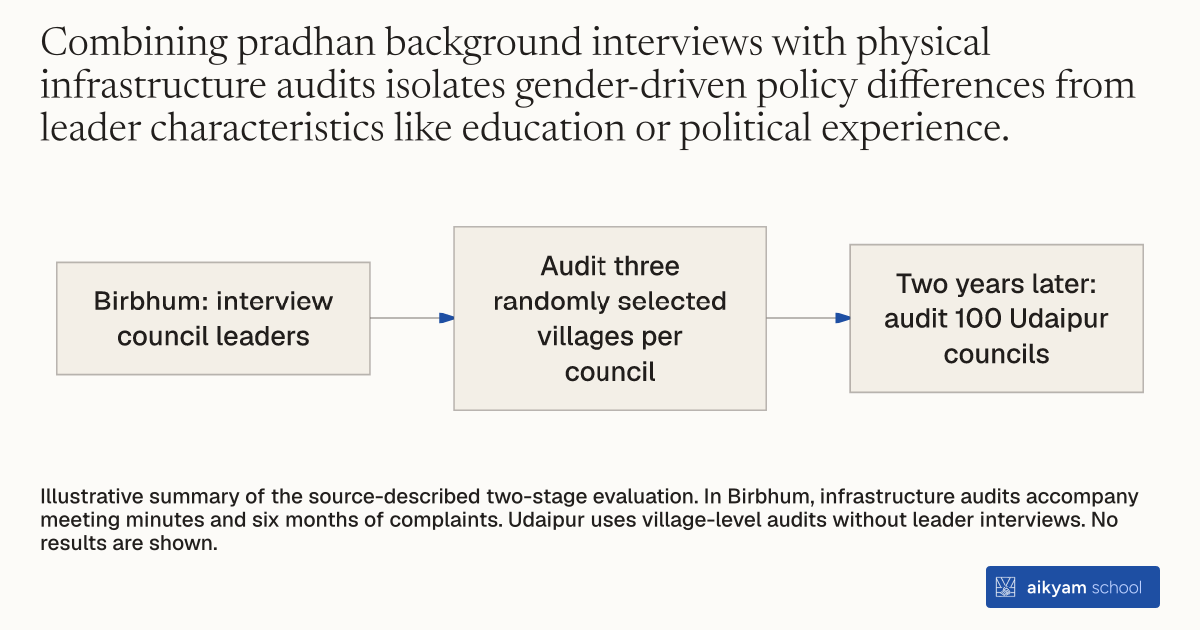
- Birbhum: interview council leaders
- Audit three randomly selected villages per council
- Two years later: audit 100 Udaipur councils
Illustrative summary of the source-described two-stage evaluation. In Birbhum, infrastructure audits accompany meeting minutes and six months of complaints. Udaipur uses village-level audits without leader interviews. No results are shown.
See source →How
When to use
Evaluating local governance interventions requires measuring public goods availability and policy responsiveness without relying solely on administrative records. Standard government reports can obscure true infrastructure quality and leader motivations. Conduct a two-stage evaluation combining leader interviews and randomized village-level public goods audits to assess policy impacts on rural populations.
Execute a two-stage data collection process to evaluate local leadership characteristics, public goods provision, and citizen policy preferences across village councils.
- Interview each village council pradhan regarding family background, education level, political experience, political ambitions, and recent council activities.
- Randomly select three villages from the five to fifteen villages represented by each village council for direct field surveying.
- Audit available public goods and existing infrastructure across all selected villages to measure physical investments.
- Collect official minutes from bi-annual village meetings to verify financial reporting and council proceedings.
- Gather complaint logs submitted to the village council over the preceding six months to document citizen preferences by gender.
Why it works
Randomly sampling villages and auditing physical assets ensures unbiased measurement of council spending outcomes.
Example
In Birbhum, West Bengal, researchers interviewed pradhans across village councils and surveyed public goods in 3 randomly chosen villages per council, while collecting 6 months of complaint logs and meeting minutes; two years later, researchers surveyed 100 village councils in Udaipur, Rajasthan using village-level infrastructure audits without pradhan interviews.
About the study
Participants
265 village councils across Birbhum in West Bengal and Udaipur in Rajasthan, India, serving rural civil servants and rural populations.
Study Design
Two-stage evaluation in a randomized controlled trial: stage one interviewed pradhans in Birbhum on background and ambitions, and stage two audited public goods across 3 randomly selected villages per council while reviewing meeting minutes and 6 months of citizen complaint logs, followed by village-level audits across 100 councils in Udaipur.
Results
Auditing public goods revealed that female-led reserved councils in West Bengal built 9 more drinking water facilities and improved roads by 18 percent, matching women's complaints (31 percent water, 31 percent roads), while in Rajasthan reserved councils built 2.62 more drinking water facilities and reduced road improvements by 8 percent, matching women's complaints (54 percent water, 13 percent roads).