Research flow
Assign lines, then workers
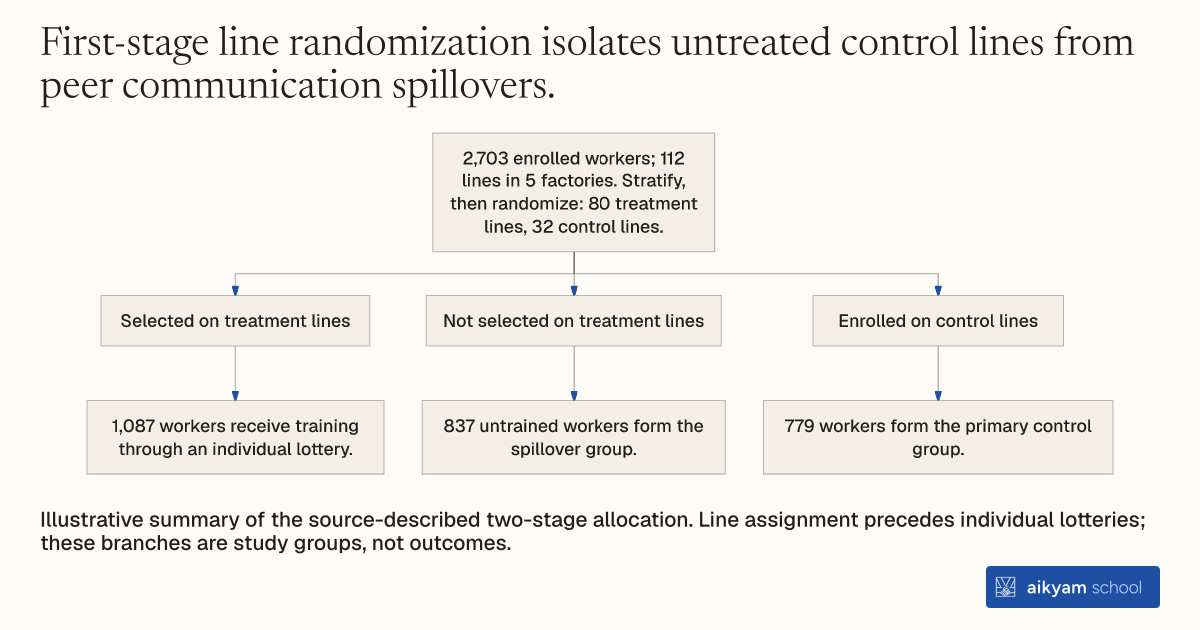
2,703 enrolled workers; 112 lines in 5 factories. Stratify, then randomize: 80 treatment lines, 32 control lines.
- Selected on treatment lines
- 1,087 workers receive training through an individual lottery.
- Not selected on treatment lines
- 837 untrained workers form the spillover group.
- Enrolled on control lines
- 779 workers form the primary control group.
Illustrative summary of the source-described two-stage allocation. Line assignment precedes individual lotteries; these branches are study groups, not outcomes.
See source →How
When to use
Evaluating firm-based workplace interventions often suffers from selection bias when motivated employees self-select into training. Factory production constraints also make it difficult to train entire teams simultaneously without disrupting daily operations. Execute a two-stage randomized lottery assignment across manufacturing lines and individual workers to measure direct and spillover productivity effects.
Randomize production units and enrolled workers in two sequential stages to construct clean control and spillover groups.
- Collect voluntary program enrollment from interested frontline employees across all participating factory lines.
- Stratify production lines by factory unit, baseline efficiency, baseline attendance, and lottery enrollment rates.
- Randomize roughly two-thirds of the production lines within each factory to treatment status and the remaining lines to control status.
- Assign a fixed number of enrolled workers on each treatment line to receive training via a randomized individual lottery.
- Keep remaining enrolled workers on treatment lines untrained to form a spillover comparison group.
- Designate enrolled workers on control lines as the primary control group.
Why it works
Second-stage individual lotteries eliminate self-selection bias among interested workers while maintaining required factory staffing levels during production hours.
Example
Researchers evaluated a workplace training program across 5 garment export factories in Bengaluru, India containing 112 production lines. From 2,703 female workers who enrolled in the lottery, the team assigned 80 lines to treatment and 32 lines to control, randomly selecting 1,087 workers for direct training, 837 workers for spillover monitoring, and 779 workers for control.
About the study
Participants
2,703 female garment workers across 112 production lines in 5 factories in Bengaluru, India (1,087 treated, 837 spillover, 779 control).
Study Design
Two-stage randomized controlled trial with line-level randomization stratified by factory, efficiency, attendance, and enrollment, followed by individual worker lottery selection within treatment lines.
Results
Two-stage randomization confirmed zero baseline differences across groups, detecting a 10.8 percentage point efficiency increase among treated workers (p < 0.05) and an 8.02 person-day gain among spillover workers (p < 0.05).