Research steps
Verify reports and device wearing
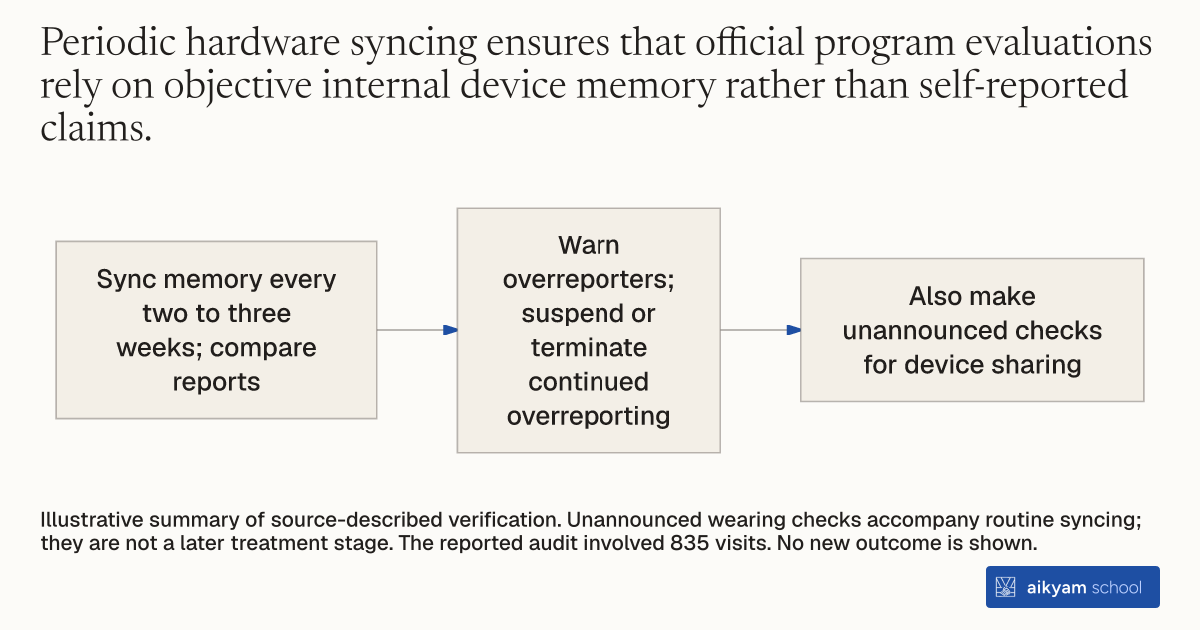
- Sync memory every two to three weeks; compare reports
- Warn overreporters; suspend or terminate continued overreporting
- Also make unannounced checks for device sharing
Illustrative summary of source-described verification. Unannounced wearing checks accompany routine syncing; they are not a later treatment stage. The reported audit involved 835 visits. No new outcome is shown.
See source →How
When to use
Health programs that reward self-reported activity need ways to detect fraud, overreporting, or device sharing. Unverified self-reports can compromise study data and lead to improper incentive payouts. This method serves programs monitoring tracked exercise behavior through field verification in community settings.
Conduct periodic field visits and unannounced home checks to sync physical device memory and verify self-reported activity data.
- Deploy field workers to visit participants at their homes or workplaces every two to three weeks during the program.
- Connect participants' pedometers to an internet-enabled device to upload internal step memory to the central server.
- Compare daily step entries submitted via telephone calls against physical device memory logs.
- Issue an official warning to any participant whose telephone reports exceed verified pedometer data.
- Suspend or terminate individuals from the incentive program if overreporting continues after warnings.
- Perform unannounced home audit visits to verify that participants are personally wearing their assigned devices rather than sharing them.
Why it works
Random unannounced home checks discourage device sharing by creating a constant probability of detection.
Example
Surveyors conducted 835 unannounced home audit visits across Coimbatore, India, to verify that participants wore their assigned pedometers. Audit records confirmed that participants were not sharing their devices in 99.6 percent of visits.
About the study
Participants
2,559 participants in incentive and monitoring arms in Coimbatore, India, with an average age of 49.56 years, 42 percent female, 67 percent diagnosed diabetic, and an average monthly per capita income of 4,465 INR.
Study Design
Surveyors conducted biweekly home visits to sync pedometer hardware memory and ran 835 unannounced home visits to audit device wearing and prevent device sharing during a 12-week intervention.
Results
Unannounced audits showed 99.6 percent adherence to individual pedometer wearing without device sharing, while hardware syncing identified and limited data discrepancies across 205,732 participant-days.