Research assessment
Observe unannounced patient visits
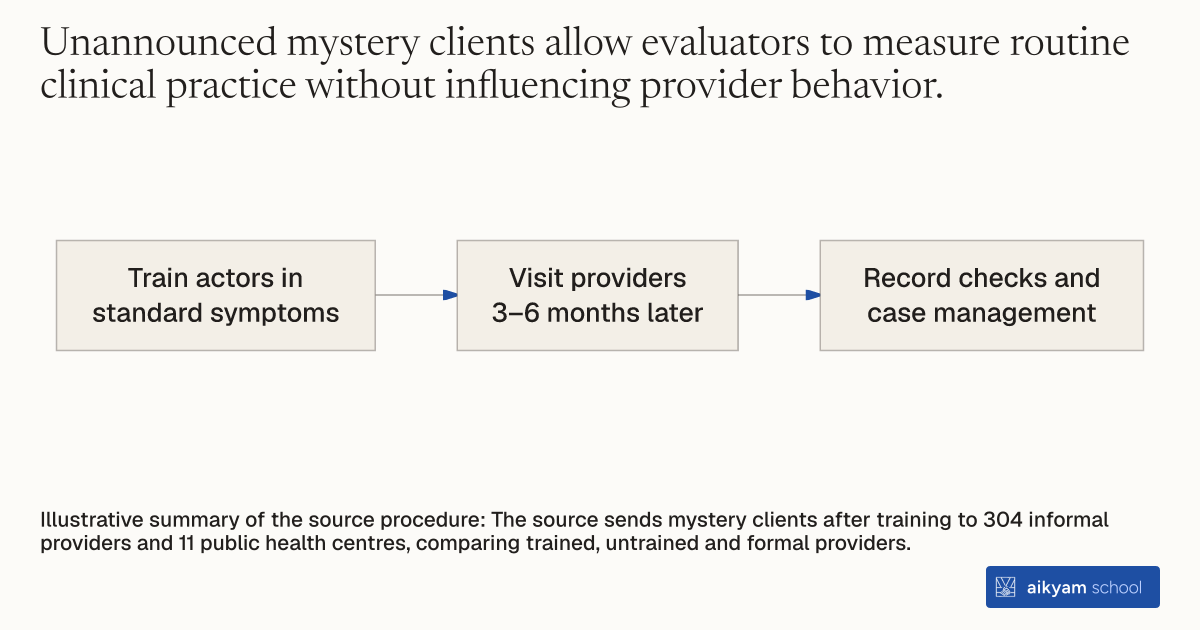
- Train actors in standard symptoms
- Visit providers 3–6 months later
- Record checks and case management
Illustrative summary of the source procedure: The source sends mystery clients after training to 304 informal providers and 11 public health centres, comparing trained, untrained and formal providers.
See source →How
When to use
Evaluating clinical quality in healthcare settings is challenging because providers often alter their behavior when observed. Program evaluators need an objective method to measure routine clinical practices during everyday consultations. Send trained actors playing mystery clients to healthcare providers to evaluate clinical performance and diagnostic quality without inducing observer bias.
Deploy trained actors as unannounced mystery clients to evaluate provider clinical performance across standard medical scenarios.
- Train actors to play standard patient roles presenting specific symptoms such as chest pain, respiratory distress, or child diarrhea.
- Send mystery clients unannounced to visit informal healthcare providers three to six months after program completion.
- Send mystery clients to local public health centers to record benchmark performance data from formal medical doctors.
- Observe provider diagnostic actions, condition-specific checklist completion, and case management during the interaction.
- Record clinical findings, prescribed treatments, and provider recommendations immediately following each visit.
Why it works
Standardized patient roles ensure consistent clinical encounters, enabling accurate comparisons across different provider groups.
Example
In West Bengal, India, researchers sent mystery clients presenting chest pain, respiratory distress, or child diarrhea to 304 informal providers and 11 public health centers. Trained informal providers delivered correct case management in 60 percent of interactions, compared to 52 percent for untrained comparison providers.
About the study
Participants
304 informal healthcare providers and 11 public health centers across 203 communities in West Bengal, India.
Study Design
Randomized evaluation using unannounced mystery client visits three to six months after training to compare trained informal providers against untrained comparison providers and formal public doctors.
Results
Correct case management reached 60 percent among trained informal providers (an 8 percentage point increase over comparison providers), while condition-specific checklist completion reached 31 percent (a 4 percentage point increase).