Research steps
Test stored drinking water at an unannounced visit
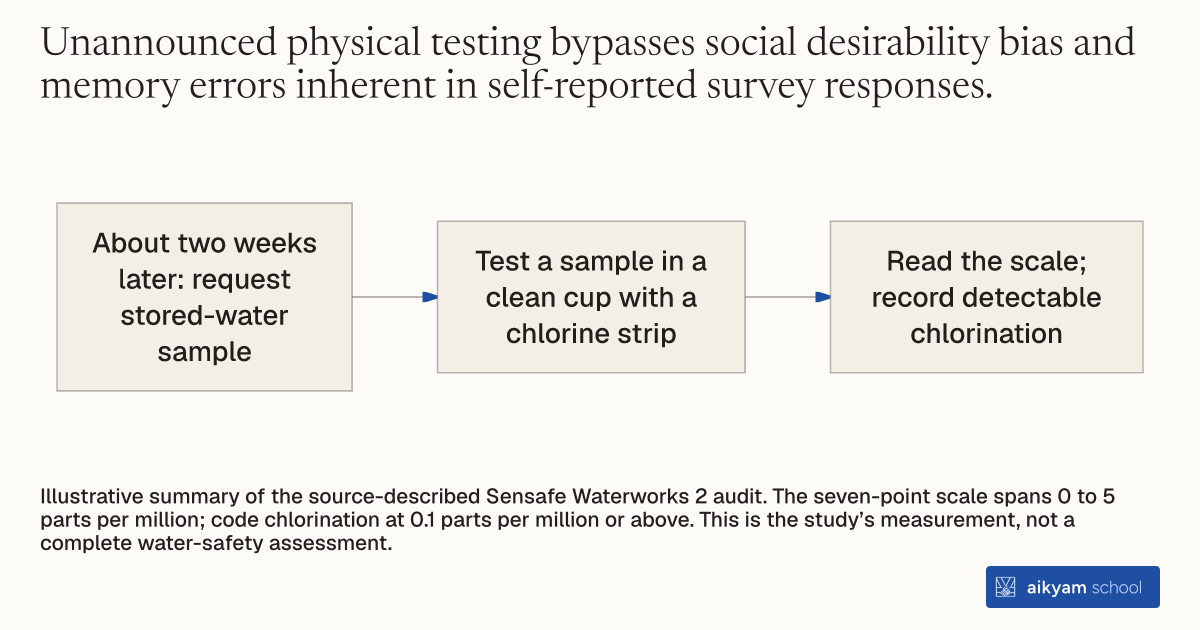
- About two weeks later: request stored-water sample
- Test a sample in a clean cup with a chlorine strip
- Read the scale; record detectable chlorination
Illustrative summary of the source-described Sensafe Waterworks 2 audit. The seven-point scale spans 0 to 5 parts per million; code chlorination at 0.1 parts per million or above. This is the study’s measurement, not a complete water-safety assessment.
See source →How
When to use
Self-reported health surveys often suffer from social desirability bias, leading respondents to overstate compliance with health interventions. Surveying households without objective verification makes it difficult to measure true product adoption rates. This method uses unannounced visits and chemical test strips to measure actual water treatment objectively.
Measure household water treatment compliance using unannounced field audits and chemical test strips.
- A trained surveyor makes an unannounced visit to the household approximately two weeks after product distribution.
- The surveyor asks the primary caretaker if drinking water is stored in the household and requests a small sample.
- The surveyor pours a portion of the stored drinking water into a clean Styrofoam cup.
- The surveyor inserts a Sensafe Waterworks 2 test strip directly into the cup to measure free chlorine residuals.
- The surveyor matches the test strip color against a seven-point scale ranging from 0 to 5 parts per million.
- The surveyor records a binary indicator of active chlorination if free chlorine is detected at 0.1 parts per million or higher.
Why it works
Measuring free chlorine radicals provides a precise chemical indicator of pathogen-killing capability in stored drinking water.
Example
Surveyors visited 890 households across five periurban compounds in Lusaka, Zambia, two weeks after a marketing experiment. Water testing revealed that 53.3 percent of purchasing households had free chlorine residuals in their drinking water, compared to 78 percent who self-reported using the product.
About the study
Participants
890 households recontacted (out of 1,004 reached during marketing) in low-income periurban compounds in Lusaka, Zambia.
Study Design
Unannounced household follow-up audits conducted approximately two weeks after door-to-door sales, testing stored drinking water samples with Sensafe Waterworks 2 test strips calibrated for free chlorine residual concentrations (0 to 5 parts per million).
Results
Chemical test strips detected free chlorine (0.1 parts per million or greater) in 53.3 percent of purchasing households, whereas self-reported use among the same buyers was 51.5 percent to 78 percent across survey rounds. Pearson chi-square tests confirmed a strong statistical relationship between self-reported use and measured chlorination (p < 0.001).