Research records
Compare counts from randomly assigned lists
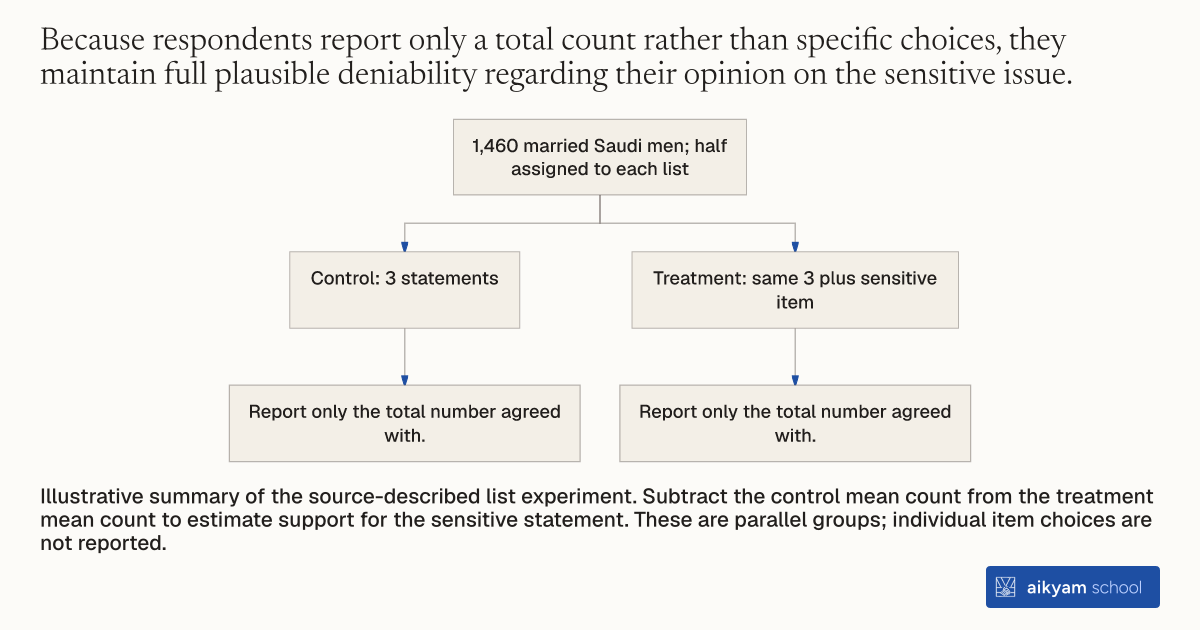
1,460 married Saudi men; half assigned to each list
- Control: 3 statements
- Report only the total number agreed with.
- Treatment: same 3 plus sensitive item
- Report only the total number agreed with.
Illustrative summary of the source-described list experiment. Subtract the control mean count from the treatment mean count to estimate support for the sensitive statement. These are parallel groups; individual item choices are not reported.
See source →How
When to use
In survey settings involving sensitive or stigmatized topics, respondents often alter their answers to conform to expected social norms. Direct questioning under these conditions causes social desirability bias that masks true preferences. Implementing a list experiment gives respondents plausible deniability, allowing researchers to measure true population-level support.
Elicit sensitive private preferences by presenting randomized control and treatment groups with lists of statements and asking only for the total count of agreed items.
- Administrator randomly divides survey respondents into a control group and a treatment group.
- Administrator presents control participants with a list of non-sensitive, contentious policy statements.
- Administrator presents treatment participants with the exact same control list plus one sensitive statement of interest.
- Administrator instructs participants in both groups to read all statements and report only the total number of statements they agree with.
- Researcher calculates the average number of agreed statements in the control group.
- Researcher calculates the average number of agreed statements in the treatment group.
- Researcher subtracts the control mean from the treatment mean to determine the true proportion of support for the sensitive statement.
Why it works
This eliminates social desirability bias and experimenter demand effects, yielding an accurate measure of private support.
Example
In a national online survey of 1,460 married Saudi men aged 18 to 35, researchers assigned half the sample to a 3-item control list and half to a 4-item list containing a statement supporting women working outside the home. The list experiment revealed 80.46% private support, confirming that social desirability bias did not distort the 82.42% support found under direct questioning.
About the study
Participants
1,460 married Saudi males aged 18 to 35 from cities across Saudi Arabia, forming a nationally representative sample.
Study Design
Randomized survey experiment comparing direct elicitation in a control group against item-count elicitation (list experiment) in a treatment group.
Results
Inferred support for women working outside the home from the list experiment was 80.5% (80.46%), compared to 82.4% (82.42%) under direct elicitation. Both measures confirmed that over 80% of young married men privately supported female employment outside the home, while 92% of respondents underestimated peer support.