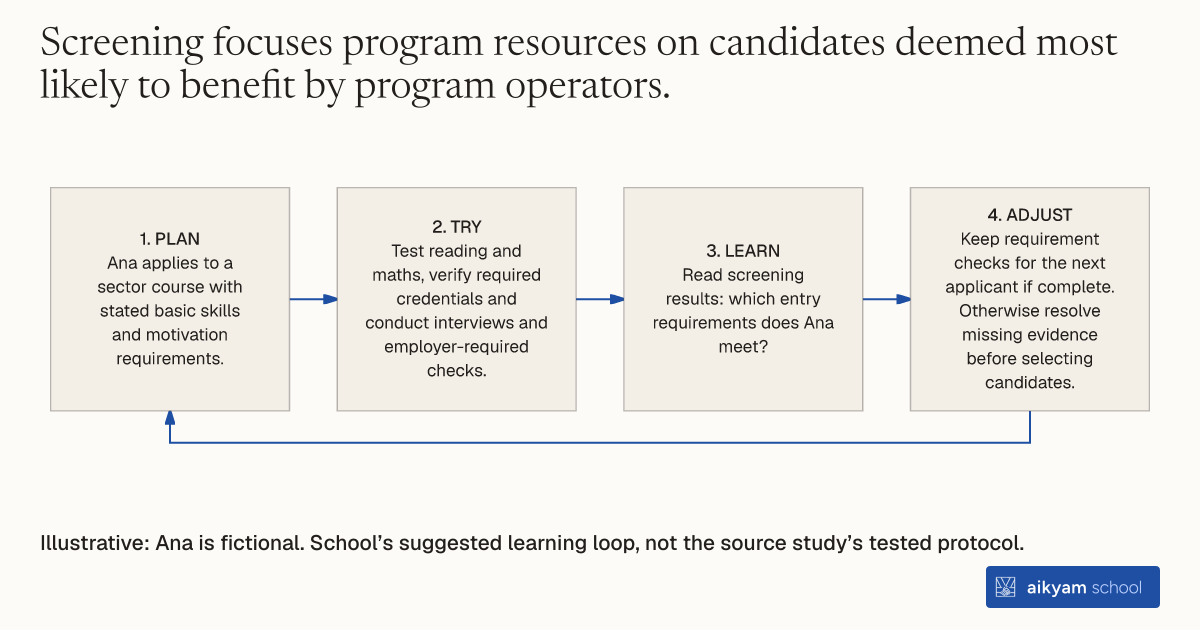
Try, learn and adjust
Check applicant requirements before enrolment
- Plan: Ana applies to a sector course with stated basic skills and motivation requirements.
- Try: Test reading and maths, verify required credentials and conduct interviews and employer-required checks.
- Learn: Read screening results: which entry requirements does Ana meet?
- Adjust: Keep requirement checks for the next applicant if complete. Otherwise resolve missing evidence before selecting candidates.
Illustrative: Ana is fictional. School’s suggested learning loop, not the source study’s tested protocol.
See source →School’s suggested, untested learning loop. Observe basic skills, motivation and required credentials; screening alone does not explain programme earnings gains.
How
When to use
Low-income job seekers often face barriers when entering high-wage technical sectors without formal college degrees. Unscreened enrollment risks assigning intensive training resources to candidates unequipped for complex curricula. Upfront screening solves this problem for program operators by identifying applicants with the baseline skills and motivation needed to succeed.
Screen applicants for basic skills and motivation prior to technical training enrollment.
- Administer reading and math tests to verify applicant academic levels between 6th grade and 10th grade.
- Verify high school diplomas or GED credentials when technical tracks require formal secondary completion.
- Evaluate applicant motivation using structured interviews or behavioral assessments.
- Conduct drug screens, background checks, or mechanical aptitude exams where target employers require them.
- Select qualifying candidates for enrollment into sector-focused training cohorts.
Why it works
Selective entry ensures participants possess the foundational capabilities required to complete occupational training.
Example
Per Scholas in the Bronx tested applicants at a 10th grade level in math and reading while requiring a high school diploma or GED credential.
About the study
Participants
Human adult job seekers without college degrees across nine sectoral training programs in the United States.
Study Design
Four randomized evaluations compared outcomes of screened applicants assigned to sectoral training against control group members receiving standard services.
Results
Screened participants across Sectoral Employment Impact Study sites earned $4,500 more (an 18 percent increase) than control group members over two years.