Try, learn and adjust
Check the status and terms of proposed bylaws
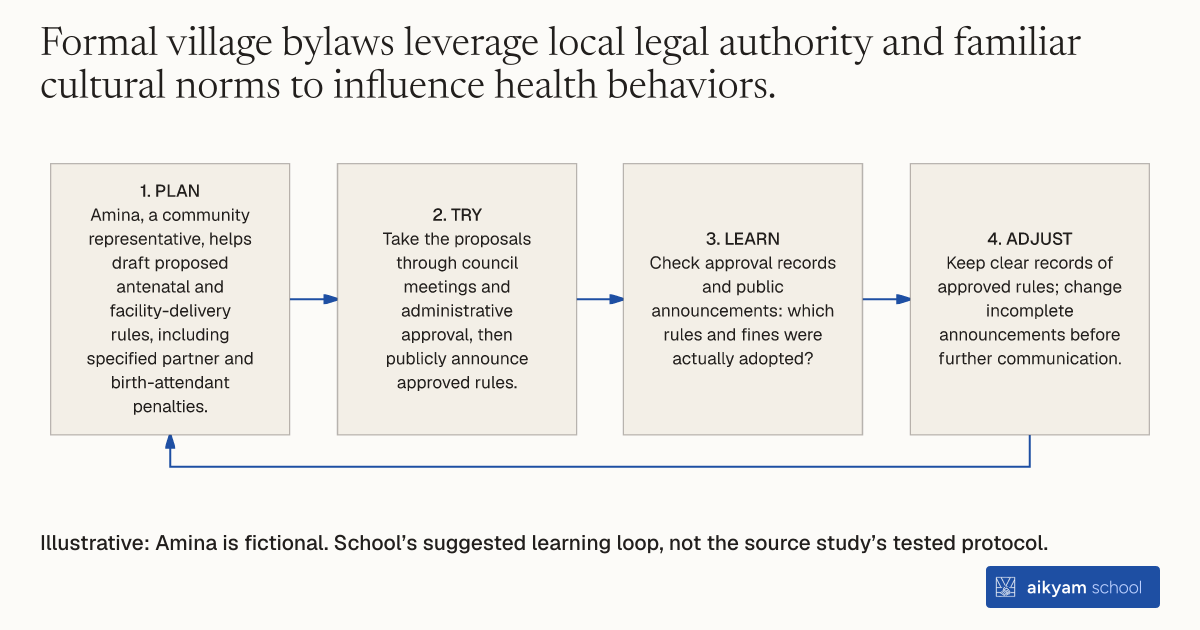
- Plan: Amina, a community representative, helps draft proposed antenatal and facility-delivery rules, including specified partner and birth-attendant penalties.
- Try: Take the proposals through council meetings and administrative approval, then publicly announce approved rules.
- Learn: Check approval records and public announcements: which rules and fines were actually adopted?
- Adjust: Keep clear records of approved rules; change incomplete announcements before further communication.
Illustrative: Amina is fictional. School’s suggested learning loop, not the source study’s tested protocol.
See source →Observe proposals, approval and announcements. The source reports community actions, not evidence that fines improve maternal health. School suggests this learning loop; it was not tested by the source.
How
When to use
Rural communities experience low health facility utilization and frequent home births without skilled birth attendants. Local village leaders need enforceable rules to discourage unsafe delivery practices and compel family support. Program organizers establish local bylaws with monetary fines to increase maternal health service uptake among pregnant women and their partners.
Enact and enforce village-level legal rules that mandate compliance with maternal health services through financial penalties.
- Draft village bylaws specifying mandatory attendance for antenatal care appointments and health facility deliveries.
- Establish specific monetary fines for men who fail to accompany pregnant partners to medical check-ups.
- Institute financial penalties for traditional birth attendants who deliver babies in home settings without a certified midwife present.
- Pass the proposed bylaws through formal village council meetings and obtain local administrative approval.
- Announce the newly enacted bylaws publicly across sub-villages to inform community members of enforced fines.
Why it works
Financial penalties create a direct incentive for families to prioritize facility care and deter unauthorized home deliveries.
Example
In Tanzanian program villages, community representatives drafted local bylaws fining unsupportive partners and traditional birth attendants who performed home births, contributing to 41.0% of Tanzanian communities establishing bylaws during the 90-day intervention.
About the study
Participants
200 rural villages across two regions in Indonesia and two regions in Tanzania, involving 100 intervention communities in each country.
Study Design
Randomized controlled trial evaluating a non-prescriptive social accountability intervention, tracking community action plan goals and self-reported completion across 90 days.
Results
Bylaws were designed by 22.0% of communities overall, including 41.0% of Tanzanian villages compared to 3.0% of Indonesian villages, with 79.6% of health uptake pathway actions completed in Tanzania within 90 days.