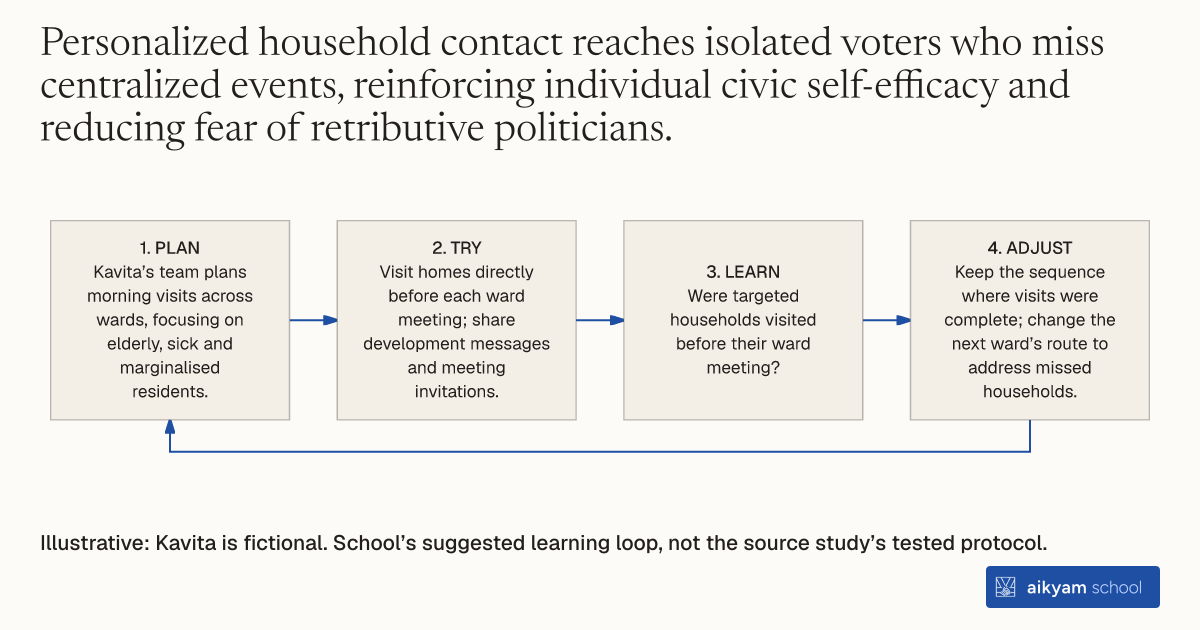
Try, learn and adjust
Check vulnerable residents receive household outreach
- Plan: Kavita’s team plans morning visits across wards, focusing on elderly, sick and marginalised residents.
- Try: Visit homes directly before each ward meeting; share development messages and meeting invitations.
- Learn: Were targeted households visited before their ward meeting?
- Adjust: Keep the sequence where visits were complete; change the next ward’s route to address missed households.
Illustrative: Kavita is fictional. School’s suggested learning loop, not the source study’s tested protocol.
See source →School’s suggested learning loop, not a tested source procedure. Observe household coverage and visit timing; the study tested a larger mobilisation campaign.
How
When to use
During election campaigns in rural areas, elderly, sick, and marginalized citizens frequently face mobility barriers or social exclusion that prevent them from attending public political rallies. Ward-level door-to-door canvassing addresses this by bringing non-partisan civic messages directly to individual households prior to broader community meetings. This ensures that vulnerable voters receive key information about candidate quality and democratic participation.
Conduct targeted door-to-door household visits across every village ward immediately before holding ward meetings to deliver non-partisan campaign messages to vulnerable residents.
- Deploy a two-person campaign team to systematically visit every ward within a village on the morning of a campaign day.
- Focus household outreach specifically on elderly, sick, and marginalized residents who cannot easily attend public gatherings.
- Inform household members about scheduled campaign meetings and invite them to attend.
- Deliver non-partisan campaign messages encouraging citizens to evaluate candidates on local development and performance.
- Execute each door-to-door drive in each ward directly prior to holding that ward's meeting.
Why it works
This direct contact mobilizes underrepresented groups and ensures widespread absorption of non-partisan campaign arguments.
Example
In rural Uttar Pradesh, India, a two-person field team from the NGO Sarathi conducted pre-meeting door-to-door visits in each ward across treated villages during the 2007 state assembly election campaign. This direct canvassing was part of an intensive one-day mobilization effort that achieved a 20 percentage point increase in reported exposure to NGO campaigns (10% in control vs 30% in treatment) and boosted male turnout by 11 percentage points.
About the study
Participants
The trial evaluated 36 polling-station clusters across Lalitpur, Bahraich, and Sitapur districts in rural Uttar Pradesh, India, surveying 1,538 Hindu voters across treated and control villages.
Study Design
Researchers implemented a randomized cluster field experiment where campaign teams conducted ward-level door-to-door drives before ward meetings, analyzing outcomes via Election Commission voter rolls and a post-election private ballot survey.
Results
The campaign increased overall voter turnout by 9% (male turnout by 11%), reduced lower-caste voting for caste-preferred parties by 10 percentage points, and halved the vote share advantage of candidates charged with heinous crimes.