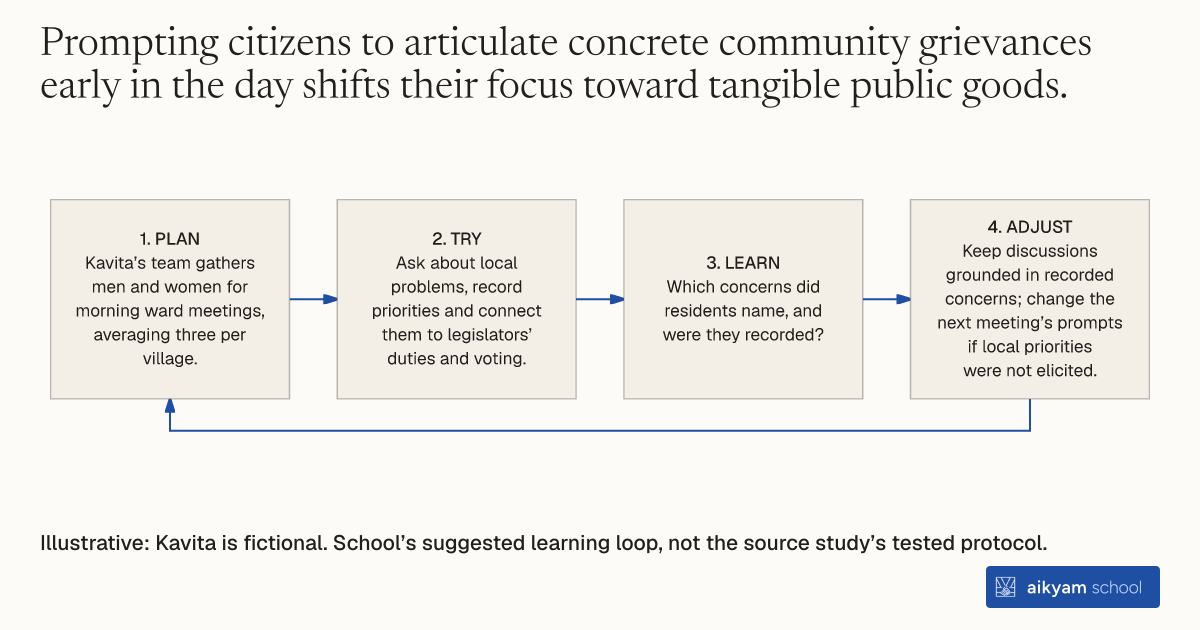
Try, learn and adjust
Check local priorities shape ward discussions
- Plan: Kavita’s team gathers men and women for morning ward meetings, averaging three per village.
- Try: Ask about local problems, record priorities and connect them to legislators’ duties and voting.
- Learn: Which concerns did residents name, and were they recorded?
- Adjust: Keep discussions grounded in recorded concerns; change the next meeting’s prompts if local priorities were not elicited.
Illustrative: Kavita is fictional. School’s suggested learning loop, not the source study’s tested protocol.
See source →School’s suggested learning loop, not a tested source procedure. Observe residents’ stated priorities and field notes; do not assume all residents share the same priorities.
How
When to use
In many rural communities, citizens rarely discuss concrete development needs before voting, relying instead on habitual caste affiliations. Ward-wise local issue identification meetings engage voters in localized discussions about infrastructure and service deficits before larger public events take place. This warm-up process helps community members surface shared priorities like sanitation, roads, and healthcare.
Hold three ward-level meetings on average per village to identify pressing local development problems and discuss the importance of civic participation.
- Deploy a two-person campaign team to assemble residents in each ward during the morning.
- Facilitate open group discussions asking men and women to name their top local infrastructure concerns.
- Record prioritized concerns, such as roads, sewage, and toilets for men, and pensions, sanitation, and health for women.
- Connect identified community problems to the responsibility of elected legislators for local service delivery.
- Emphasize the importance of voting based on candidate capacity to solve these specific local problems rather than caste loyalty.
Why it works
This discussion frames legislative elections around service delivery and candidate quality instead of identity politics.
Example
An NGO team conducted an average of three ward meetings per village across 36 clusters in rural Uttar Pradesh, India, during the 2007 state assembly election. Men prioritized roads, political issues, and sewage, while women prioritized pensions, toilets, and health. The overall voter priming effort reduced lower-caste voting for caste-preferred parties by 10 percentage points and increased male voter turnout by 11 percentage points.
About the study
Participants
The trial evaluated 36 polling-station clusters across Lalitpur, Bahraich, and Sitapur districts in rural Uttar Pradesh, India, surveying 1,538 Hindu voters.
Study Design
Researchers tested ward-level issue meetings as part of a randomized cluster field experiment, measuring voter priorities via field notes and evaluating voting outcomes through post-election surveys and official Election Commission returns.
Results
Ward meetings successfully engaged citizens around distinct priorities (roads and sewage for men; pensions and health for women), contributing to a 9% increase in overall turnout and a reduction in support for caste-preferred candidates with criminal records from 57.6% to 47.6%.