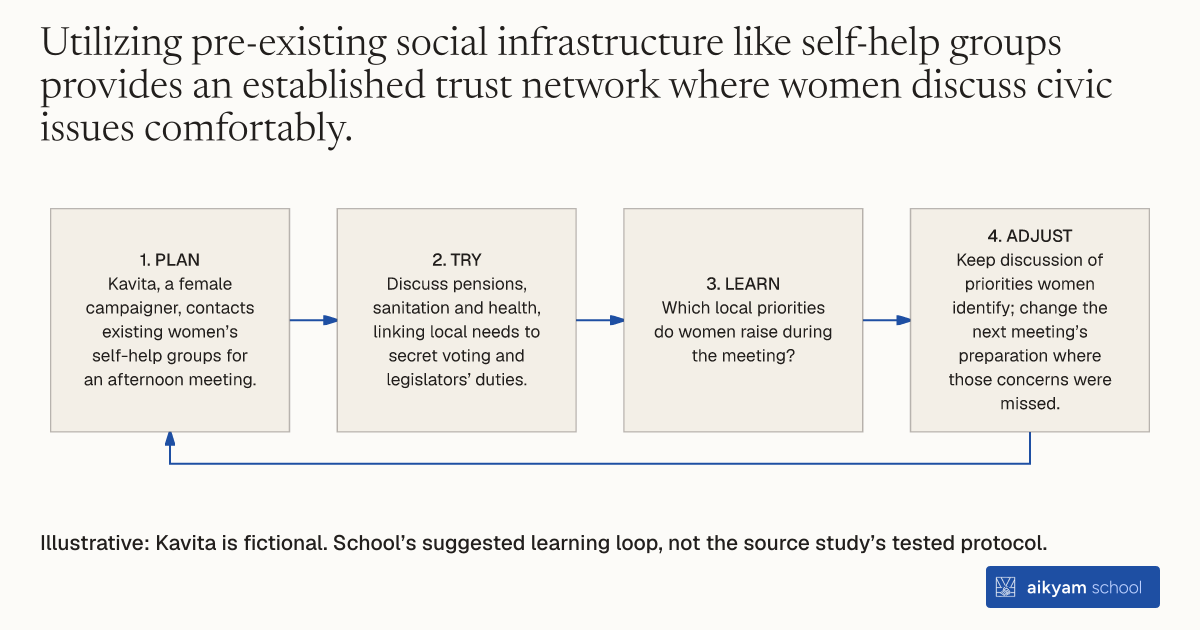
Try, learn and adjust
Check women’s priorities enter the discussion
- Plan: Kavita, a female campaigner, contacts existing women’s self-help groups for an afternoon meeting.
- Try: Discuss pensions, sanitation and health, linking local needs to secret voting and legislators’ duties.
- Learn: Which local priorities do women raise during the meeting?
- Adjust: Keep discussion of priorities women identify; change the next meeting’s preparation where those concerns were missed.
Illustrative: Kavita is fictional. School’s suggested learning loop, not the source study’s tested protocol.
See source →School’s suggested learning loop, not a tested source procedure. Observe women’s stated priorities and meeting participation; the study evaluated the full campaign.
How
When to use
Female voters in rural developing regions often face lower political participation, restricted access to information, and distinct development priorities. Women's self-help group campaign meetings address these barriers by mobilizing female citizens through pre-existing community networks during an election campaign. This provides a dedicated space for rural women to discuss local governance issues and non-partisan electoral priorities.
Convene targeted campaign meetings with pre-existing village women's self-help groups and female residents during the afternoon of a campaign day.
- Deploy a female NGO campaigner to connect with local women's self-help groups in the village.
- Assemble self-help group members and village women in an accessible afternoon meeting location.
- Facilitate discussions focused on women's specific local priorities, including pensions, toilets, sewage, and healthcare facilities.
- Connect these development needs to the responsibility of elected legislators for local service delivery.
- Deliver non-partisan campaign messages encouraging women to cast secret ballots based on candidate quality rather than caste loyalty or household directives.
Why it works
Addressing female-specific development concerns increases political awareness and voting efficacy among women.
Example
During the 2007 Uttar Pradesh state assembly election, NGO field teams from Sarathi conducted women's self-help group meetings across treated villages in central India. Women identified pensions, toilets, and health as their top concerns, contributing to an overall 20 percentage point increase in reported NGO exposure and a 7 percentage point increase in female turnout.
About the study
Participants
The trial evaluated 36 polling-station clusters across Lalitpur, Bahraich, and Sitapur districts in rural Uttar Pradesh, India, surveying 1,538 Hindu respondents including SC and OBC women.
Study Design
Researchers evaluated the meetings as part of a randomized cluster field experiment where two-person campaign teams held women-only group sessions, assessing results through a post-election survey and official voter rolls.
Results
Survey data showed women prioritized pensions, toilets, and health; exposure to NGO campaigns increased by 20 percentage points in treated villages, and female voter turnout rose by 7 percentage points (log votes point estimate 0.070; p > 0.1).