Try, learn and adjust
Check weekly yarn stock from daily transactions
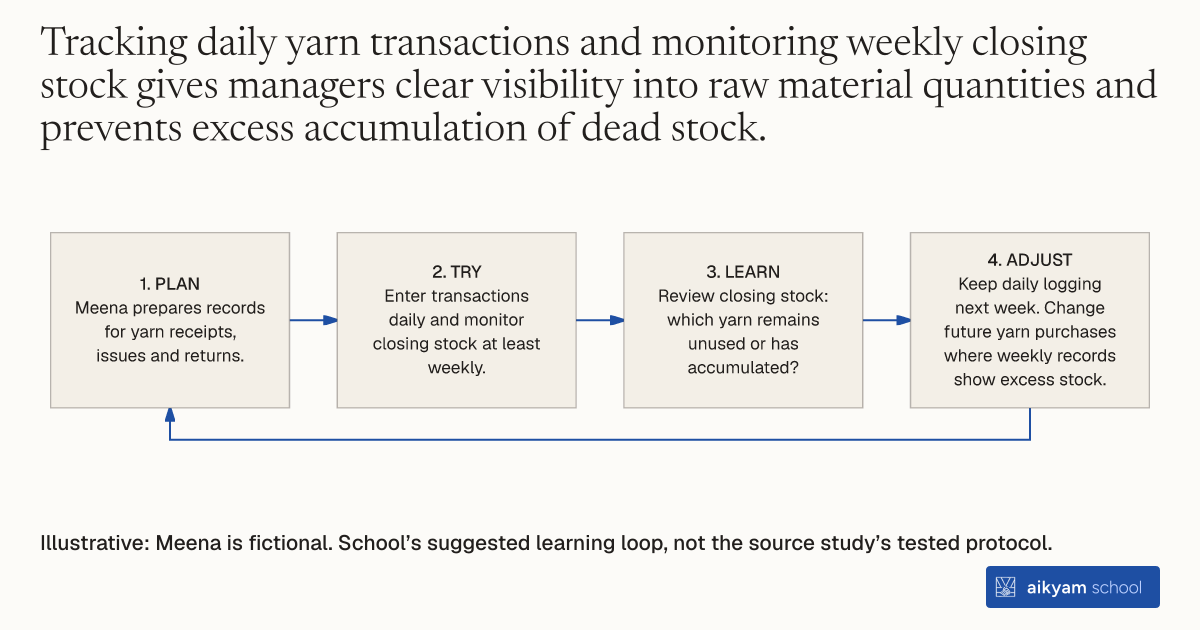
- Plan: Meena prepares records for yarn receipts, issues and returns.
- Try: Enter transactions daily and monitor closing stock at least weekly.
- Learn: Review closing stock: which yarn remains unused or has accumulated?
- Adjust: Keep daily logging next week. Change future yarn purchases where weekly records show excess stock.
Illustrative: Meena is fictional. School’s suggested learning loop, not the source study’s tested protocol.
See source →Observe daily transactions and weekly closing quantities. School suggests this learning loop; it is not the source’s tested procedure.
How
When to use
Many textile factories hold several months of raw yarn inventory without knowing exact quantities, leading to dead stock and tied-up capital. Storekeepers often fail to track incoming yarn receipts and outgoing issues to weaving looms on a daily basis. This method helps plant managers monitor closing stock weekly and record daily yarn transactions to eliminate excess inventory.
Record yarn receipts and issues daily while monitoring total closing yarn stock on a weekly basis to optimize inventory levels.
- Warehouse staff log every yarn shipment received at the factory gate on a daily basis.
- Storekeepers record all yarn issued to weaving looms and returned unused yarn daily.
- Inventory clerks enter daily yarn transaction records into computerized tracking systems.
- Plant managers monitor total closing yarn stock at least once per week.
- Production directors evaluate weekly closing stock data to identify dead stock and adjust future yarn purchases.
Why it works
This structured inventory monitoring enables firms to establish restocking norms and sell off unused surplus yarn.
Example
International consultants introduced weekly stock monitoring and daily transaction logging to woven cotton textile plants near Mumbai, India, helping treatment plants reduce yarn inventory by 21.7%.
About the study
Participants
28 plants across 17 large, family-owned cotton textile weaving firms in Tarapur and Umbergaon near Mumbai, India, averaging 273 employees and $7.45 million in annual sales per firm.
Study Design
Randomized controlled trial providing 11 treatment firms with 5 months of management consulting and 6 control firms with 1 month of diagnostic consulting, tracking weekly data across ~100 weeks.
Results
Monitoring weekly closing stock and recording daily yarn transactions contributed to a 21.7% reduction in yarn inventory (p = 0.060), while raising daily yarn transaction recording adoption from 21.4% to 78.5% and weekly closing stock monitoring adoption from 92.9% to 100% in treatment plants.