Try, learn and adjust
Check consumption support during asset start-up
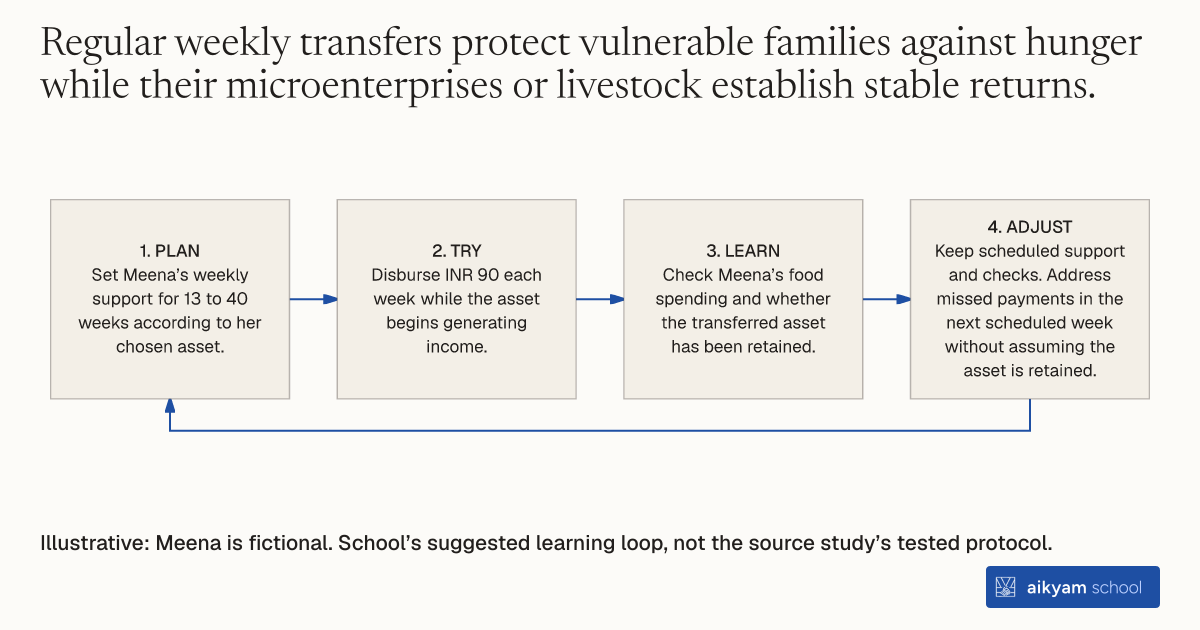
- Plan: Set Meena’s weekly support for 13 to 40 weeks according to her chosen asset.
- Try: Disburse INR 90 each week while the asset begins generating income.
- Learn: Check Meena’s food spending and whether the transferred asset has been retained.
- Adjust: Keep scheduled support and checks. Address missed payments in the next scheduled week without assuming the asset is retained.
Illustrative: Meena is fictional. School’s suggested learning loop, not the source study’s tested protocol.
See source →School’s suggested, untested loop. Observe payment receipt, food spending and asset retention; this does not isolate cash support’s effect.
How
When to use
Extremely poor households often face immediate food insecurity while waiting for newly transferred assets to generate earnings. Without short-term cash support, families are forced to take low-paying casual labor or sell assets to eat. Program teams provide temporary weekly cash transfers so ultra-poor households can cover daily consumption needs during asset gestation.
Deliver weekly cash transfers to ultra-poor households to cover basic living expenses while transferred productive assets begin generating income.
- Determine the incubation period required for the productive asset selected by the participant.
- Schedule weekly cash payments for a duration between 13 and 40 weeks depending on the chosen asset.
- Organization staff disburse a cash transfer of INR 90 directly to the participant each week.
- Verify that households use the stipend to meet immediate food spending without liquidating their transferred asset.
Why it works
This prevents distress sales of assets and avoids forcing adults into insecure casual labor.
Example
In West Bengal, India, Bandhan provided weekly cash transfers of INR 90 for 13 to 40 weeks to 514 ultra-poor households following asset transfers. Thirty months after the asset transfer, average monthly consumption among treatment households reached 73 US dollars compared to 67 US dollars in comparison households.
About the study
Participants
978 ultra-poor households in Murshidabad, West Bengal, India, consuming 40 US dollars per month on average.
Study Design
Randomized controlled trial comparing 514 households receiving consumption support within the 18-month Graduation package against 464 comparison households over ten years.
Results
Total monthly consumption among treatment households reached 73 US dollars thirty months after asset transfer compared to 67 US dollars in comparison households, representing a 9 percent increase.