Research monitoring
Check actual clinic availability
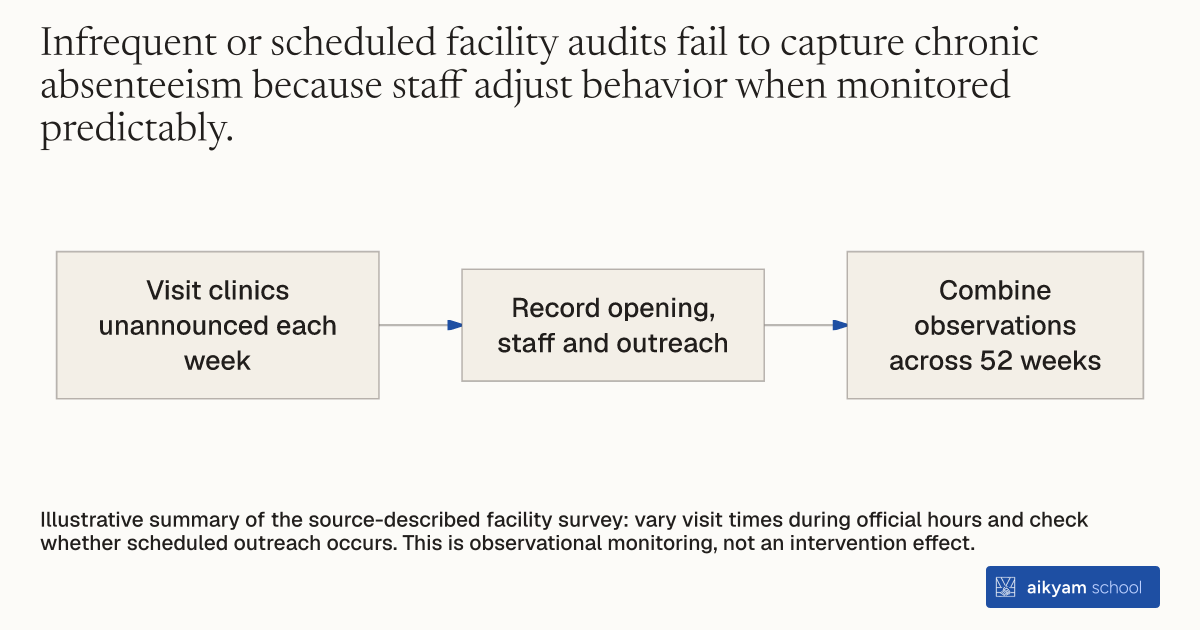
- Visit clinics unannounced each week
- Record opening, staff and outreach
- Combine observations across 52 weeks
Illustrative summary of the source-described facility survey: vary visit times during official hours and check whether scheduled outreach occurs. This is observational monitoring, not an intervention effect.
See source →How
When to use
Health sector administrators and researchers need to evaluate whether public healthcare delivery failures stem from facility unreliability and provider absenteeism. Conducting unannounced, regular checks reveals actual facility open hours and service availability. This method helps health programs diagnose structural supply-side barriers to preventive care in rural areas.
Conduct unannounced weekly surveys across public health facilities to measure operating hours and staff attendance over an extended period.
- Select a representative sample of local public health clinics and sub-centers across target rural areas.
- Deploy survey enumerators to visit each facility at unannounced, varying times once per week.
- Record whether the clinic is open or closed during official operating hours.
- Document the presence or absence of assigned health personnel and nurses.
- Check for scheduled peripheral health activities, such as rural outreach immunization camps, to verify if they occur as planned.
- Aggregate weekly attendance data across 52 weeks to quantify overall system reliability.
Why it works
Unannounced weekly monitoring measures actual service availability and identifies specific supply-side failures that discourage rural populations from seeking preventive care.
Example
Researchers conducted a yearlong weekly survey of public health facilities in rural Udaipur, Rajasthan, to evaluate clinic reliability. They found that local health clinics were closed more than half the time and discovered essentially no trace of scheduled village immunization camps.
About the study
Participants
Public health clinics and local sub-centers across 100 rural villages in Udaipur district, Rajasthan, India over a 52-week period.
Study Design
A yearlong, weekly unannounced observational survey of public health facilities to monitor facility open rates and staff presence.
Results
Public health clinics offering preventive healthcare services were closed more than half the time, and scheduled village immunization camps were virtually non-existent.