Research procedure
Compare costs with earnings gains
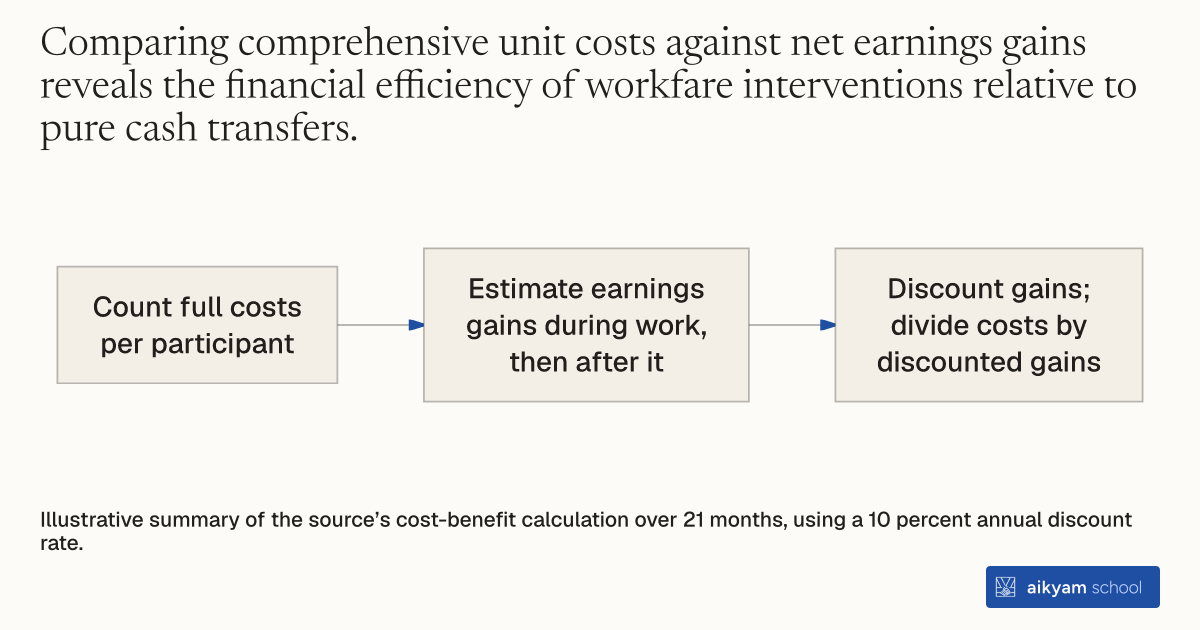
- Count full costs per participant
- Estimate earnings gains during work, then after it
- Discount gains; divide costs by discounted gains
Illustrative summary of the source’s cost-benefit calculation over 21 months, using a 10 percent annual discount rate.
See source →How
When to use
Public works programs require substantial administrative and capital expenditures beyond direct wage transfers to beneficiaries. Evaluators and policymakers need to measure financial return by comparing implementation costs against short-term and post-program earnings gains. This method evaluates whether temporary workfare programs justify their operational costs relative to direct cash transfers.
Evaluate workfare cost-effectiveness by comparing total per-participant costs to the discounted sum of earned income gains.
- Itemize total per-beneficiary costs, including direct wage payments, team supervisor salaries, work materials, training activities, and indirect management overhead.
- Estimate average monthly earnings gains during program employment relative to non-selected control applicants.
- Measure average monthly earnings gains during the post-program period across follow-up survey rounds.
- Calculate the discounted sum of total earnings gains from program entry through post-program follow-up using a monthly discount factor.
- Divide total per-beneficiary implementation cost by the discounted sum of total earnings gains to produce the cost-benefit ratio.
Why it works
Incorporating operational and supervisory expenses prevents overestimating economic returns from public employment schemes.
Example
In Côte d'Ivoire, evaluators calculated the cost-effectiveness of a public works program costing 768,708 CFA francs per participant across 16 urban localities. Direct transfers to workers accounted for 354,166 CFA francs, while equipment, supervisor wages, training, and management made up the remaining cost. Over a 21-month evaluation horizon, discounted earnings gains totaled 253,920 CFA francs per participant, resulting in a baseline cost-benefit ratio of 3.03.
About the study
Participants
4,160 urban youth aged 18 to 30 years across 16 localities in Côte d'Ivoire evaluated at midline and endline.
Study Design
Randomized controlled trial tracking 3,125 beneficiaries and 1,035 control applicants, combined with cost-benefit modeling discounting monthly earnings gains over 21 months at a 10 percent annual discount rate.
Results
Total program cost per beneficiary was 768,708 CFA francs, while discounted earnings gains totaled 253,920 CFA francs, producing a baseline cost-benefit ratio of 3.03 (costs were 3.03 times higher than direct earnings benefits). Under alternative targeting of women or proxy means testing, the cost-benefit ratio improved to 2.33 and 1.99 respectively, increasing cost-effectiveness by 23 percent to 34 percent.