In Simple Words
Imagine a student who starts using an online homework portal. If using the portal causes them to stop studying with their physical textbook for the exact same number of hours, the portal produces zero net additional study time. But if their textbook studying remains unchanged, the portal creates genuine extra learning effort rather than swapping one habit for another.
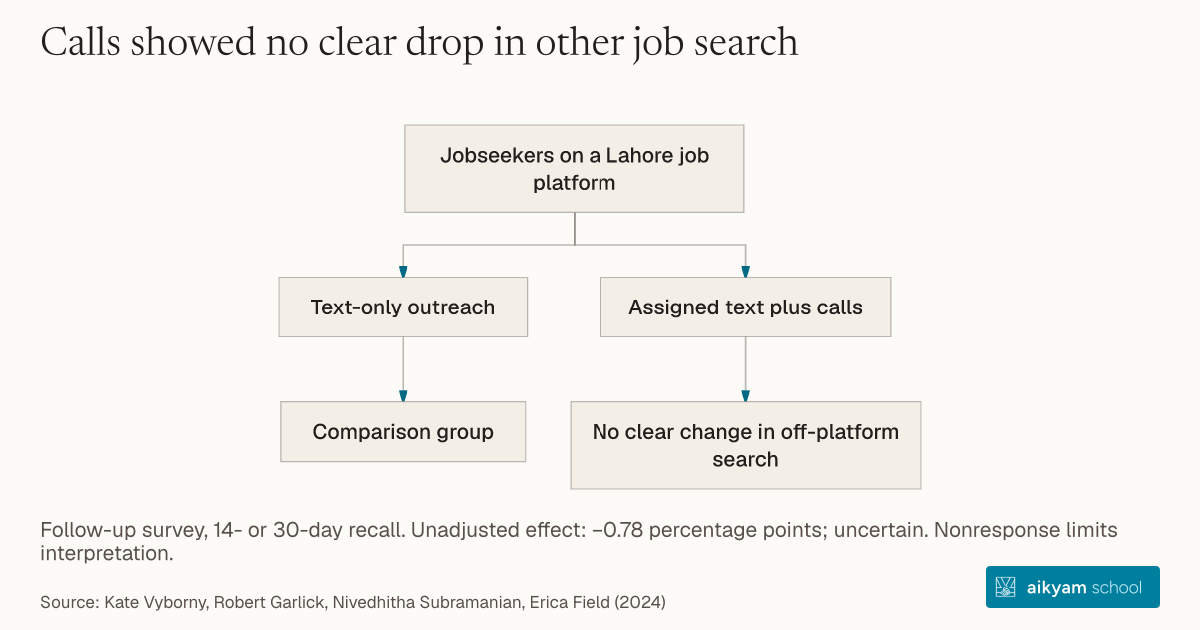
Jobseekers on a Lahore job platform
- Text-only outreach
- Comparison group
- Assigned text plus calls
- No clear change in off-platform search
Follow-up survey, 14- or 30-day recall. Unadjusted effect: −0.78 percentage points; uncertain. Nonresponse limits interpretation.
See source →Research question
Digital labor platform interventions that increase on-platform application activity might simply displace or crowd out traditional, off-platform job search effort (such as direct applications or newspaper ads), resulting in zero net change in total search activity.
Participants
N = 9,823 jobseekers (survey sample N = 4,327 for search, N = 4,643 for employment) in Lahore, Pakistan.
Study Design
Randomized Controlled Trial measuring off-platform search and employment outcomes using 14-day and 30-day recall surveys with selection adjustments for survey non-response.
Results
Phone call treatment changed off-platform search probability by -0.78 percentage points (p = 0.632) and monthly off-platform applications by -0.188 (p = 0.201). Off-platform employment probability changed by +0.18 percentage points (p = 0.910 unadjusted; +1.08 percentage points, p = 0.589 adjusted).
Takeaway
Evaluate digital matching platform interventions on total employment outcomes without assuming digital applications displace non-digital job search channels.
Source and citation
See source →Read alongside the research
Plain-English glossary
Original explanations, informed by the references below. Examples are illustrations, not data from the studies above. The research text stays unchanged.
- Percentage points
The difference between two percentages.
ExampleA rise from 40% to 50% is 10 percentage points. Relative to the starting value, that is a 25% increase.
Office for National Statistics · Percentages ↗Read more about percentage points →- Randomized controlled trial
A study that uses chance, like drawing lots, to decide who receives each option being compared. Researchers compare the groups’ outcomes to estimate the effect of those options.
ExampleA lottery assigns volunteers to a training programme or a comparison group. Researchers then compare their outcomes.
GET-IT glossary · Randomized study ↗Read more about randomized controlled trial →