Research text coding
Code recorded candidate debates
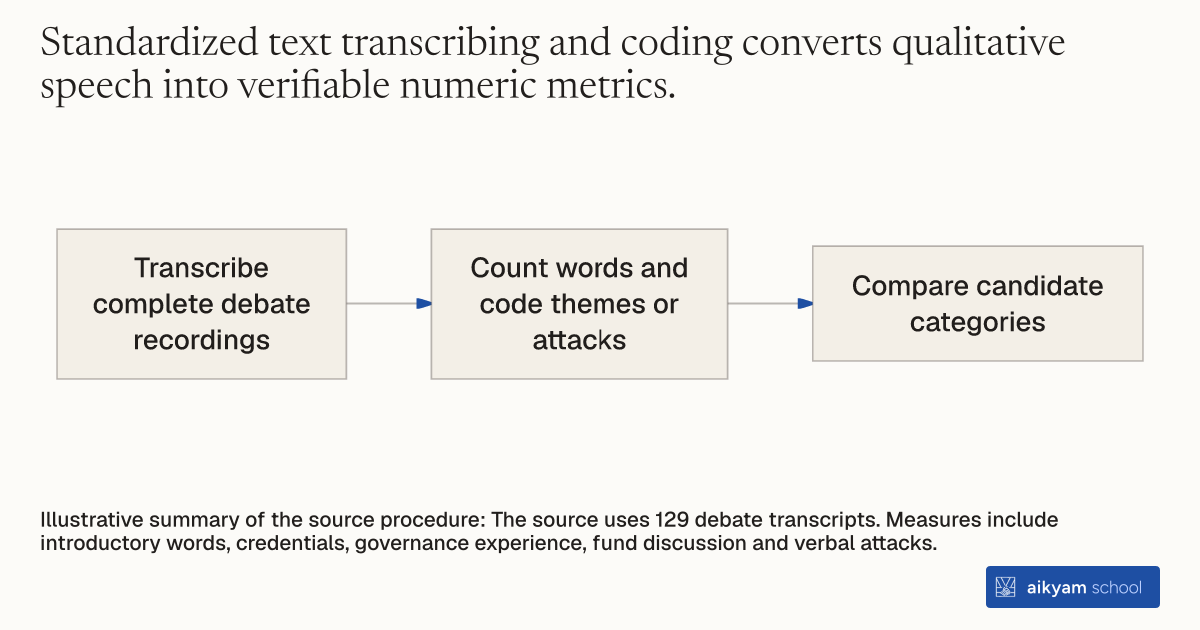
- Transcribe complete debate recordings
- Count words and code themes or attacks
- Compare candidate categories
Illustrative summary of the source procedure: The source uses 129 debate transcripts. Measures include introductory words, credentials, governance experience, fund discussion and verbal attacks.
See source →How
When to use
In political economy evaluations, relying solely on voter recall to analyze candidate debate behavior introduces recall bias and subjective distortion. Researchers need a standardized method to quantify candidate discourse, speaking time, and policy rhetoric. This approach transcribes full audio recordings of political candidate debates and codes text variables across candidate types.
Code debate content and candidate behavior by transcribing audio recordings into standardized text datasets.
- Hire trained local journalists to transcribe complete audio recordings of electoral district candidate debates.
- Count the number of words spoken by each participating candidate during introductory campaign statements.
- Code binary indicators for whether candidates emphasize educational credentials versus prior governance experience during introductions.
- Count the specific word counts dedicated by each candidate to discussing management of discretionary public development funds.
- Code binary indicators measuring whether candidates verbally attack political opponents or face verbal attacks from rival candidates.
- Compare coded transcript metrics across candidate categories to quantify differences in candidate sophistication, platform depth, and debate dynamics.
Why it works
This allows evaluators to confirm whether debate moderators enforce equal speaking time and to test whether incumbents and challengers emphasize fundamentally different qualifications.
Example
Internews and newspaper journalists transcribed audio from 129 legislative candidate debates across Liberia's 73 electoral districts in 2017. Text coding revealed that incumbents spoke significantly more words about discretionary County Social Development Funds (398.2 words vs. 284.7 for challengers) and highlighted prior experience over educational achievements (33 percent vs. 26 percent).
About the study
Participants
Transcripts from 129 district debates involving 984 legislative candidates across all 73 electoral districts in Liberia in 2017.
Study Design
Systematic text coding of full debate transcripts evaluating candidate introductory word counts, educational versus experience emphasis, fund management discussion length, and verbal attacks across candidate categories.
Results
Incumbents spoke an average of 340.3 introductory words (compared to 352.0 for challengers), emphasized experience 33% of the time (vs. 26% for challengers), emphasized education 22% of the time (vs. 30% for challengers), spoke 398.2 words on CSDF funds (vs. 284.7 for challengers), spoke 224.0 words on LSP funds (vs. 218.0 for challengers), were attacked 19% of the time (vs. 4% for challengers), and acted as attackers 15% of the time (vs. 4% for challengers).