Try, learn and adjust
Check the factory diagnosis before recommendations
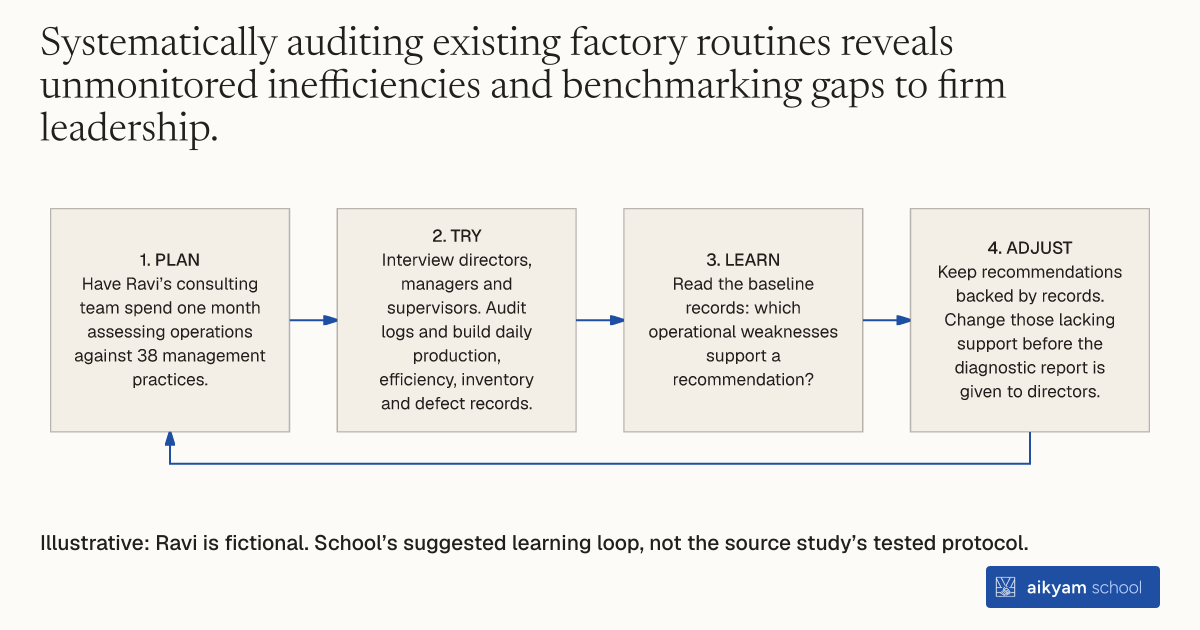
- Plan: Have Ravi’s consulting team spend one month assessing operations against 38 management practices.
- Try: Interview directors, managers and supervisors. Audit logs and build daily production, efficiency, inventory and defect records.
- Learn: Read the baseline records: which operational weaknesses support a recommendation?
- Adjust: Keep recommendations backed by records. Change those lacking support before the diagnostic report is given to directors.
Illustrative: Ravi is fictional. School’s suggested learning loop, not the source study’s tested protocol.
See source →School’s suggested, untested loop: observe baseline evidence and its link to recommendations; the next application is another diagnosis, not a repeated treatment requirement.
How
When to use
Manufacturing firms in developing countries often operate with unmonitored operational bottlenecks and unanalyzed defect data. An operational diagnostic assessment evaluates existing factory routines across core functional areas to diagnose organizational weaknesses. This method gives managers and firm owners a clear baseline measure of their management practices and specific recommendations for operational improvements.
Conduct a comprehensive one-month diagnostic evaluation to assess plant operations and create a detailed performance baseline.
- Deploy an experienced consulting team to spend one full month evaluating baseline management practices across factory operations, quality control, inventory control, human resources, and sales management.
- Interview directors, plant managers, and shop-floor supervisors to measure operations against thirty-eight standard international management practices.
- Audit existing plant logs, paper records, machine downtime sheets, and quality defect reports across all production lines.
- Construct a baseline performance database recording daily physical production, loom efficiency, inventory levels, and defect rates.
- Deliver a comprehensive diagnostic report to firm directors summarizing current operational weaknesses and detailing actionable recommendations for practice changes.
Why it works
Presenting directors with concrete plant performance data builds awareness of operational deficiencies and identifies high-priority areas for management improvement.
Example
In 2008, international consultants conducted a one-month diagnostic assessment across 20 experimental plants in 17 weaving firms near Mumbai, India. The assessment evaluated 38 baseline management practices and provided firm directors with a detailed report recommending specific operational upgrades, inducing control plants to voluntarily adopt 12 percentage points of new management practices.
About the study
Participants
28 manufacturing plants across 17 family-owned cotton weaving firms near Mumbai, India, averaging 270 employees, \$8.5 million in assets, and \$7.5 million in annual sales.
Study Design
Randomized Controlled Trial (RCT) where all 20 experimental plants (treatment and control) received the 1-month diagnostic assessment and performance recommendations in 2008.
Results
Receiving the 1-month diagnostic assessment alone caused control plants to increase adoption of 38 target management practices by 12 percentage points (from a baseline score of 0.28 in 2008 to 0.40 in 2011).