Research steps
Estimate productivity from looms per employee
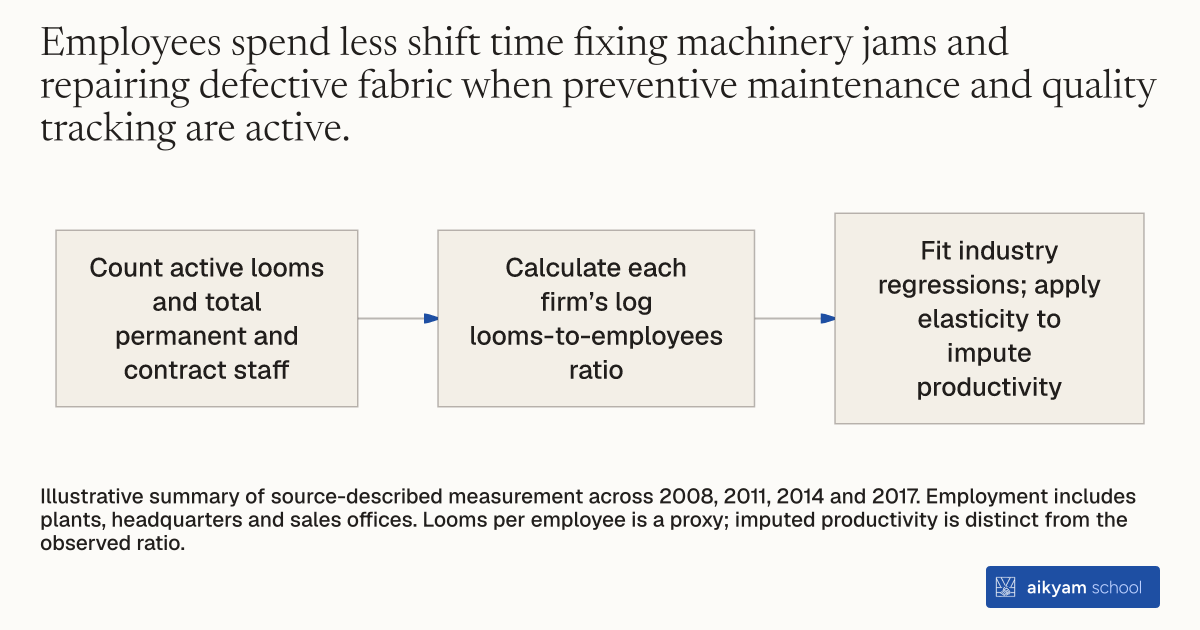
- Count active looms and total permanent and contract staff
- Calculate each firm’s log looms-to-employees ratio
- Fit industry regressions; apply elasticity to impute productivity
Illustrative summary of source-described measurement across 2008, 2011, 2014 and 2017. Employment includes plants, headquarters and sales offices. Looms per employee is a proxy; imputed productivity is distinct from the observed ratio.
See source →How
When to use
Manufacturing firms in developing countries often lack detailed financial logs to track long-term total factor productivity gains following management interventions. Tracking the ratio of active looms to production employees serves as a direct proxy for labor productivity and machine operational uptime. This method allows plant owners and researchers to evaluate sustained operational efficiency improvements without requiring complex accounting data.
Measure log looms per employee and impute physical labor productivity to track sustained plant operational efficiency.
- Plant managers and research analysts count the total number of active weaving looms operating in each manufacturing plant across survey periods.
- Production managers record total permanent and contract employment across factory plants, headquarters, and sales offices.
- Analysts calculate the log ratio of total looms to total employees for each firm to construct a standardized labor productivity proxy.
- Evaluators fit cross-sectional industry survey regressions linking log looms per worker to physical fabric production picks per worker.
- Researchers apply the fitted elasticity coefficient to impute long-term firm-level labor productivity gains over multi-year follow-up periods.
Why it works
Fewer machine breakdowns allow a single production worker to operate more active looms simultaneously, increasing overall labor output.
Example
In a 2017 follow-up study of Indian textile firms near Mumbai, researchers measured looms per employee across 17 weaving firms that had participated in a 2008 management trial. Treated firms maintained a 26.7% average increase in log looms per employee post-intervention and achieved a 51.0% long-run productivity increase by 2017.
About the study
Participants
28 manufacturing plants across 17 family-owned cotton weaving firms near Mumbai, India, averaging 270 employees, \$8.5 million in assets, and \$7.5 million in annual sales.
Study Design
Intention-to-Treat (ITT) panel regressions with firm and year fixed effects across four survey periods (2008, 2011, 2014, and 2017) using log looms per employee as a productivity proxy.
Results
Treated firms increased log looms per employee by a statistically significant 26.7% across the full post-intervention period (p=0.030) and reached a 51.0% increase in 2017 (p=0.004), imputing a long-run worker productivity gain of 35.3%.