Try, learn and adjust
Check graduate referrals match vacancies
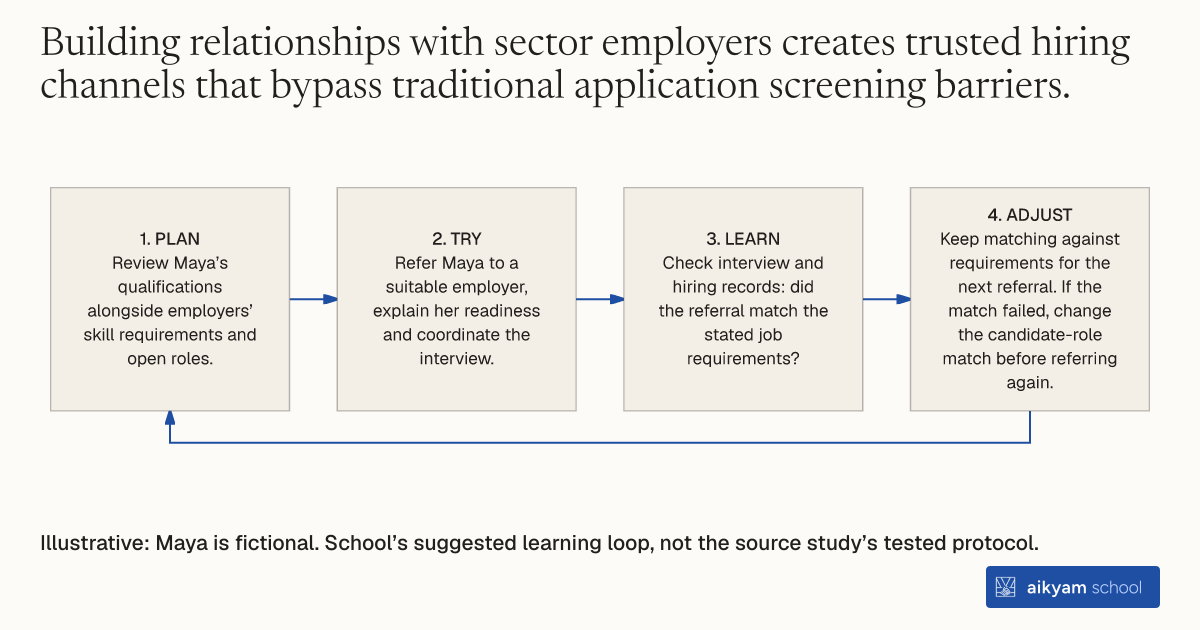
- Plan: Review Maya’s qualifications alongside employers’ skill requirements and open roles.
- Try: Refer Maya to a suitable employer, explain her readiness and coordinate the interview.
- Learn: Check interview and hiring records: did the referral match the stated job requirements?
- Adjust: Keep matching against requirements for the next referral. If the match failed, change the candidate-role match before referring again.
Illustrative: Maya is fictional. School’s suggested learning loop, not the source study’s tested protocol.
See source →School’s suggested, untested learning loop. Observe job requirements, candidate qualifications, interviews and hiring; this loop does not isolate referral effects.
How
When to use
Non-college job seekers often lack access to professional hiring networks and face informal recruitment barriers when applying for high-paying positions. Employers frequently struggle to verify candidate qualifications from non-traditional backgrounds without trusted third-party signals. Program operators solve this problem for low-income job seekers by building direct intermediary relationships with employers to generate targeted job referrals.
Build active employer networks in targeted sectors to connect program graduates directly to open positions through a referral process.
- Contact hiring managers at local firms in target sectors like healthcare, IT, and manufacturing to identify current job openings.
- Consult employers to determine specific skill requirements, entry qualifications, and job expectations for open roles.
- Review training cohort graduates to match individual candidate profiles with employer hiring needs.
- Provide direct candidate referrals and vouch for graduates' technical readiness and qualifications with hiring personnel.
- Coordinate job interviews and secure hiring commitments for program participants.
Why it works
Direct referrals and organizational endorsement overcome employer hesitation regarding candidates with non-traditional educational backgrounds.
Example
Project QUEST built close relationships with the healthcare sector in San Antonio, Texas, referring graduates directly to local healthcare employers with open positions.
About the study
Participants
Low-income adult job seekers holding a high school diploma or GED in San Antonio, Texas.
Study Design
Longitudinal Randomized Controlled Trial (RCT) evaluated by Roder and Elliott (2018, 2021) measuring earnings and employment across 6-year and 11-year post-enrollment windows.
Results
Project QUEST's employer relationships and referral model helped participants achieve an 8 percentage point increase in technical healthcare positions requiring specialized knowledge (29.4 percent versus 21.5 percent, p < 0.01) and sustained 11-year annual earnings gains of \$4,616 (a 15 percent increase, p < 0.01).