Try, learn and adjust
Check staff incentives against verified performance
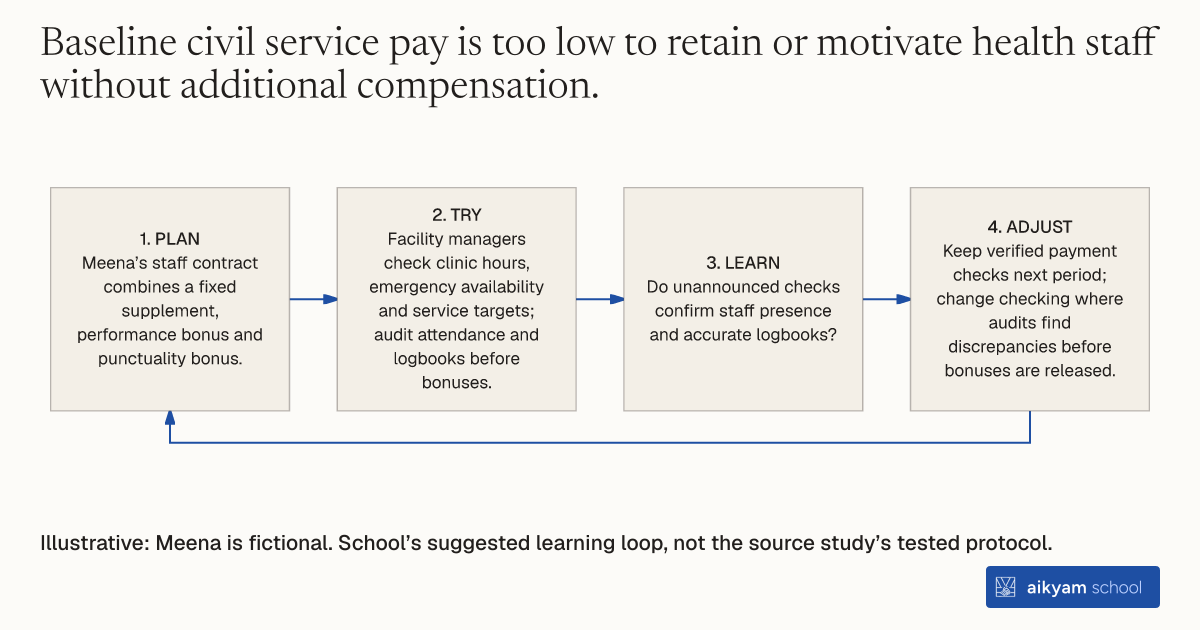
- Plan: Meena’s staff contract combines a fixed supplement, performance bonus and punctuality bonus.
- Try: Facility managers check clinic hours, emergency availability and service targets; audit attendance and logbooks before bonuses.
- Learn: Do unannounced checks confirm staff presence and accurate logbooks?
- Adjust: Keep verified payment checks next period; change checking where audits find discrepancies before bonuses are released.
Illustrative: Meena is fictional. School’s suggested learning loop, not the source study’s tested protocol.
See source →School’s suggested learning loop, not a tested source procedure. Observe attendance, service availability and logbook accuracy; the study evaluated the wider contracting arrangement.
How
When to use
Public sector health workers in developing countries earn low baseline salaries, leading to high absenteeism and under-the-table charges. Unmotivated health staff often divert patients to private practices or fail to maintain scheduled facility hours. Provide performance-based bonuses and salary supplements to public health clinic staff to motivate attendance and service delivery.
Pay public health workers salary supplements and performance-based bonuses tied to attendance and service delivery targets.
- Establish fixed supplements to baseline government salaries funded through contractor budget supplements or formalized user fees.
- Structure staff compensation into a fixed salary supplement, a performance bonus, and a punctuality bonus.
- Subcontract health facility and hospital managers to administer local staff contracts and monitor compliance.
- Set explicit performance criteria based on clinic hours, emergency availability, and target health service delivery metrics.
- Perform regular unannounced spot checks and audits to verify staff presence and logbook accuracy before disbursing bonuses.
Why it works
Direct financial rewards tied to attendance and performance metrics motivate health workers to maintain clinic availability and meet health targets.
Example
In Pereang district of Prey Veng province, HealthNet International provided health center staff with a guaranteed supplement of 55% of their government salary, a 30% performance bonus, and a 15% punctuality bonus. User fees collected at 60% of market prices funded half of these incentives, while contractor funds covered the rest. This system increased the presence of all scheduled staff at health centers by 50 percentage points.
About the study
Participants
12 rural districts in Takeo, Prey Veng, and Kampong Cham provinces in Cambodia, covering 1.26 million residents across 360 sample villages with 3,700 households and 143 health centers.
Study Design
Cluster-randomized trial evaluating 12 districts randomly assigned to contracting out, contracting in, or comparison status, using initial random eligibility as an instrumental variable for actual contract rollout.
Results
Performance-based incentives in contracting-in districts increased the probability that all scheduled staff were present on unannounced visits by 50 percentage points, increased 24-hour service availability by 83 percentage points, and improved overall targeted health outcomes by 0.51 standard deviations.