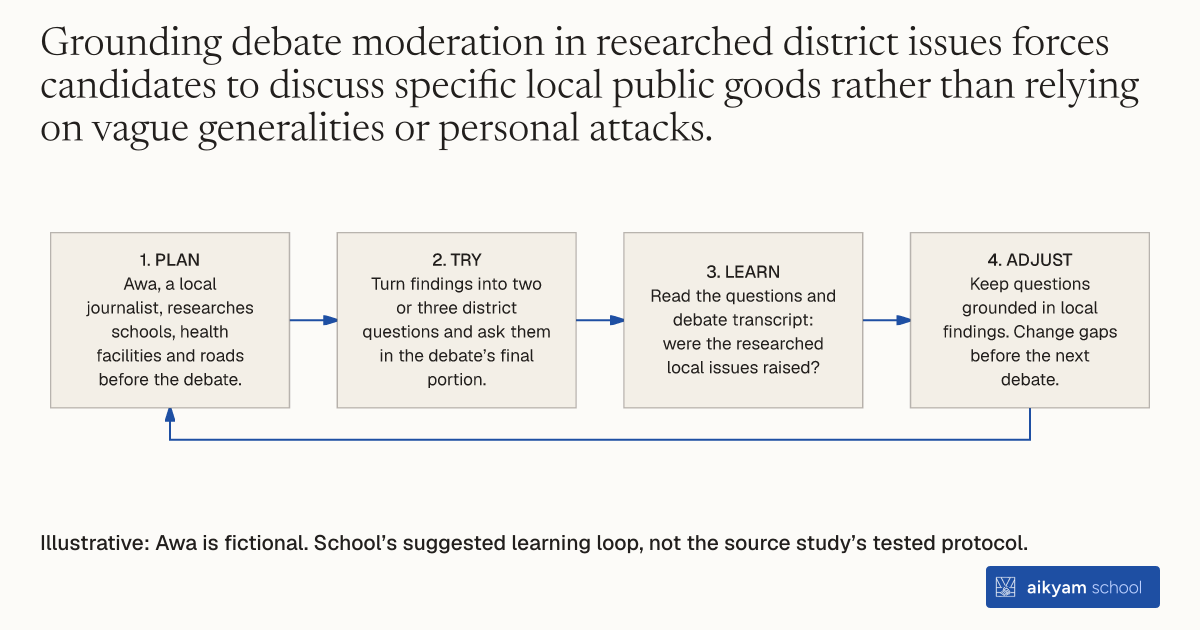
Try, learn and adjust
Check debate questions reflect local issues
- Plan: Awa, a local journalist, researches schools, health facilities and roads before the debate.
- Try: Turn findings into two or three district questions and ask them in the debate’s final portion.
- Learn: Read the questions and debate transcript: were the researched local issues raised?
- Adjust: Keep questions grounded in local findings. Change gaps before the next debate.
Illustrative: Awa is fictional. School’s suggested learning loop, not the source study’s tested protocol.
See source →School’s suggested learning loop: observe local research, questions and their use; this loop does not isolate the questions’ electoral effect.
How
When to use
In local political contests, standardized debate questions on national topics may fail to probe candidate platforms on concrete community priorities like schools, health clinics, and roads. Debate organisers need district-specific background facts to hold candidates accountable for local development choices. This method gathers pre-debate evidence on constituent priorities in each electoral district to inform debate moderation.
Conduct local issue research ahead of candidate debates to ground moderation in constituent priorities.
- Assign a local journalist to each electoral district prior to the campaign debate period.
- The local journalist conducts field research on key public service issues, including primary schools, health facilities, and local road infrastructure relevant to district constituents.
- The journalist synthesizes these findings into two or three targeted district-specific questions.
- The journalist uses these researched questions during the final portion of the standardized district candidate debate to probe candidate promises.
Example
Local journalists acting as debate moderators conducted issue research across all 73 electoral districts in Liberia prior to moderating 129 district legislative debates in August–September 2017. Moderators posed two or three researched local questions to candidates after standardized questions on development funds.
About the study
Participants
73 electoral districts and 984 legislative candidates across Liberia ahead of the October 2017 House of Representatives election.
Study Design
Nationwide field experiment testing standardized candidate debates with local issue research, coupled with randomized debate invitation intensity across 73 districts.
Results
Asking candidates standard questions and local issue questions increased voter debate policy knowledge by 0.156 standard deviations and raised overall election turnout by 1.5 percentage points in treated districts.