Try, learn and adjust
Check the agreed job plan
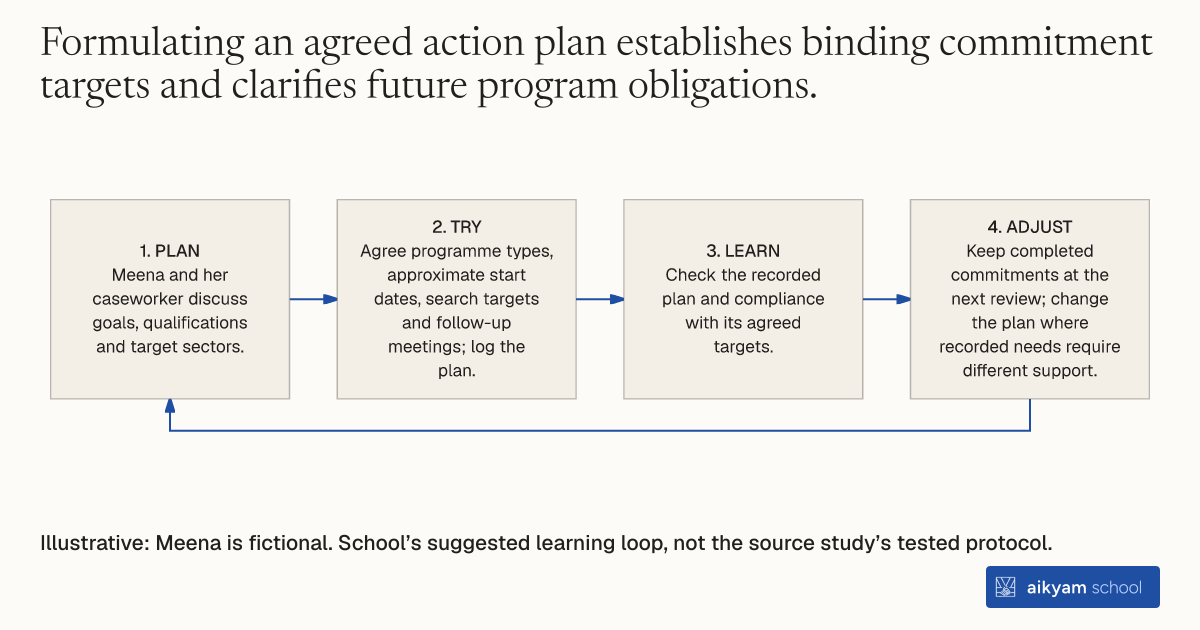
- Plan: Meena and her caseworker discuss goals, qualifications and target sectors.
- Try: Agree programme types, approximate start dates, search targets and follow-up meetings; log the plan.
- Learn: Check the recorded plan and compliance with its agreed targets.
- Adjust: Keep completed commitments at the next review; change the plan where recorded needs require different support.
Illustrative: Meena is fictional. School’s suggested learning loop, not the source study’s tested protocol.
See source →School’s suggested, untested loop. Observe agreed targets, start dates, follow-up meetings and compliance; the meeting alone does not establish employment gains.
How
When to use
Unemployed benefit recipients often lack structured goals and timelines for returning to work. Conducting a job plan meeting solves this by establishing a clear, agreed roadmap between the worker and the public employment agency. Public job centers use this method for insured job seekers during their unemployment spell.
Formulate and agree upon an individual action plan through a formal meeting between a caseworker and an unemployed client.
- Employment caseworkers schedule unemployed clients for an individual job plan meeting.
- Caseworker and worker discuss occupational goals, personal qualifications, and target employment sectors.
- Formulate an individualized job plan specifying agreed program participation types and approximate start dates.
- Set explicit job search targets and schedule subsequent contact meetings.
- Log the completed job plan into the central employment agency database to monitor compliance.
Why it works
This formal agreement structures subsequent monitoring and helps maintain worker focus on re-employment targets.
Example
Job centers in Storstrøm and Southern Jutland held job plan formulation meetings with unemployed workers during 2005 and 2006. In Storstrøm, attending a job plan meeting in the preceding two weeks produced a hazard rate coefficient of 0.09 for treatment group members and 0.12 for control group members, while Southern Jutland recorded coefficients of 0.13 for treatment and -0.04 for control group members.
About the study
Participants
N = 4,513 unemployed workers (Storstrøm: 1,174 treatment, 1,219 control; Southern Jutland: 1,055 treatment, 1,065 control) in Denmark.
Study Design
Randomized controlled trial assigning workers by birth date (1st–15th = treatment, 16th–31st = control) evaluated using mixed proportional hazard duration models with time-varying meeting indicators.
Results
Attending a job plan meeting within the past two weeks showed small, statistically non-significant direct impacts on exit rates (coefficients of 0.09 in Storstrøm treatment and 0.13 in Southern Jutland treatment), demonstrating that specific meeting events function as elements of the overall regime threat rather than independent exit drivers.