Research steps
Audit which management practices persist
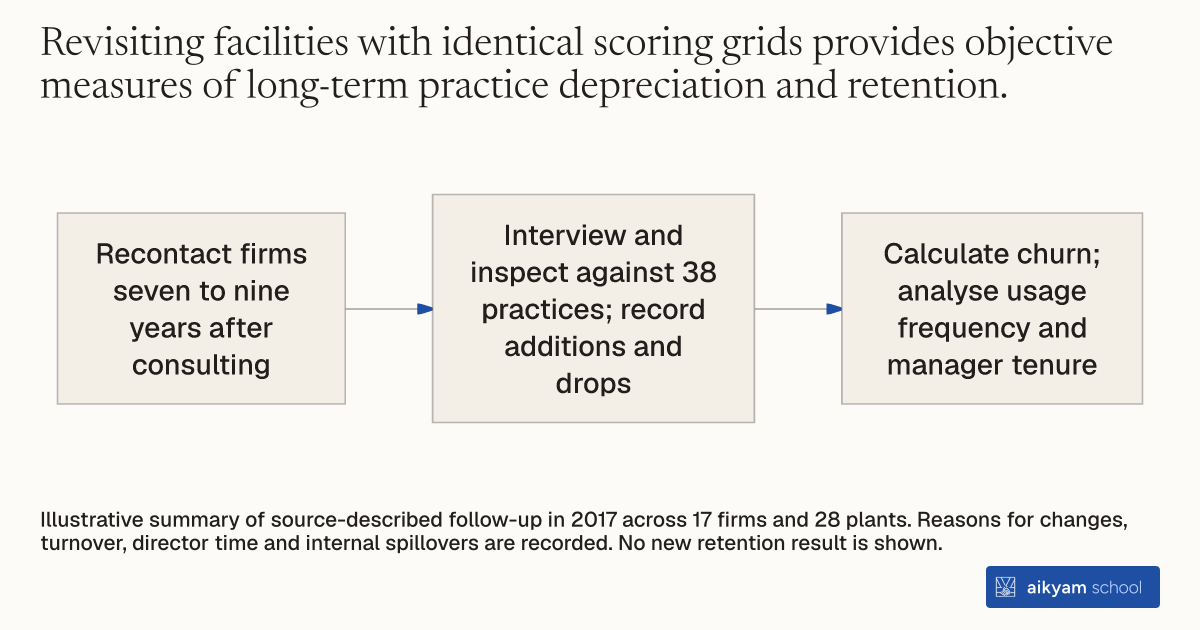
- Recontact firms seven to nine years after consulting
- Interview and inspect against 38 practices; record additions and drops
- Calculate churn; analyse usage frequency and manager tenure
Illustrative summary of source-described follow-up in 2017 across 17 firms and 28 plants. Reasons for changes, turnover, director time and internal spillovers are recorded. No new retention result is shown.
See source →How
When to use
Organizations implementing operational interventions often lack data on long-term practice retention and cannot distinguish persistent routines from discarded ones. Conducting longitudinal management audits evaluates practice adoption, addition, and drop rates across manufacturing plants over extended multi-year periods. This helps evaluators and executive leadership measure practice sustainability and identify specific organizational drivers of practice decay.
Conduct multi-year longitudinal audit surveys across manufacturing facilities to evaluate practice adoption, practice additions, and practice drops.
- Re-contact target manufacturing plants and firm directors seven to nine years after initial operational consulting interventions.
- Deploy experienced research consultants to conduct structured in-person interviews with firm directors, plant managers, and floor supervisors.
- Evaluate plant operations against thirty-eight baseline management practices using standardized scoring grids and physical plant inspections.
- Document specific reasons for every added or dropped practice across operational, quality, inventory, and human resource domains.
- Record manager turnover, director time allocation changes, and internal plant spillovers across treatment and control facilities.
- Calculate practice-by-plant churn rates and run regression models linking practice retention to baseline usage frequency and managerial tenure.
Why it works
Documenting specific reasons for practice changes identifies structural barriers to persistence, such as managerial turnover and executive attention bottlenecks.
Example
In 2017, researchers revisited 17 Indian textile firms 9 years after a 2008 management trial, evaluating 38 practices across 28 operating plants. The audit revealed that 4.1% of practices were added and 12.4% dropped between 2011 and 2017, with managerial turnover causing over half of all practice drops in treated experimental plants.
About the study
Participants
28 manufacturing plants across 17 family-owned cotton weaving firms near Mumbai, India, averaging 270 employees, \$8.5 million in assets, and \$7.5 million in annual sales.
Study Design
Randomized Controlled Trial (RCT) follow-up panel evaluation tracking 1,042 practice-by-plant cells across treatment and control facilities between 2011 and 2017.
Results
Treatment experimental plants maintained a 19.7 percentage point management score advantage over control plants in 2017 (p=0.007), despite experiencing a 6% annual depreciation rate from 2011 practice levels.