Research procedure
Model unemployment exits over time
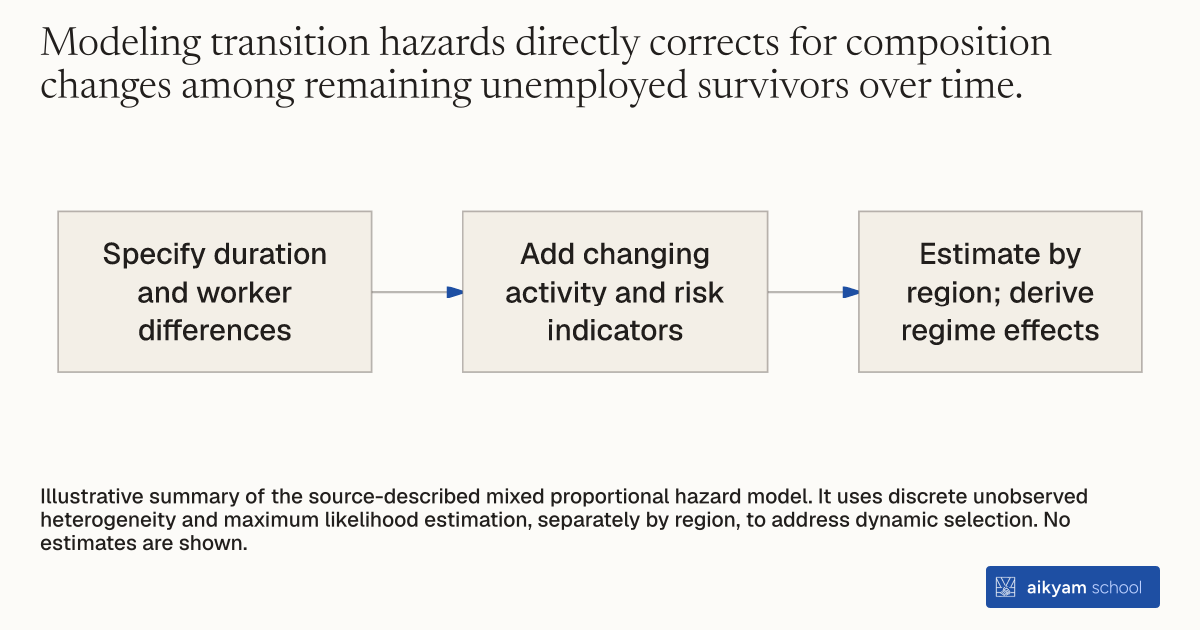
- Specify duration and worker differences
- Add changing activity and risk indicators
- Estimate by region; derive regime effects
Illustrative summary of the source-described mixed proportional hazard model. It uses discrete unobserved heterogeneity and maximum likelihood estimation, separately by region, to address dynamic selection. No estimates are shown.
See source →How
When to use
Evaluating active labor market experiments with dynamic participation over time creates dynamic selection bias as fast exiters leave the sample. Estimating transition rates with standard static estimators fails to isolate true policy impacts from unobserved survivor compositional shifts. Applying Mixed Proportional Hazard duration modeling corrects for dynamic sample selection to evaluate policy regime impacts accurately.
Estimate unemployment transition rates using a Mixed Proportional Hazard model with time-varying treatment indicators and unobserved heterogeneity controls.
- Specify baseline hazard rates as functions of elapsed unemployment duration and observed worker characteristics.
- Incorporate a discrete unobserved heterogeneity component to model underlying differences across participants.
- Include time-varying indicators for specific treatments, meetings, and estimated weekly activity risk rates.
- Estimate hazard parameters separately across administrative regions using maximum likelihood estimation.
- Derive net policy regime impacts on unemployment exit rates while controlling for dynamic sample selection.
Why it works
Disentangling dynamic risk exposure from direct activity attendance isolates threat effects from direct program impacts.
Example
Michael Rosholm applied a Mixed Proportional Hazard duration model to experimental data from 4,513 unemployed workers in Storstrøm and Southern Jutland counties during 2005–2006. The model isolated a 20% to 40% increase in unemployment exit rates attributable to regime threat expectations, shortening average unemployment duration by 2.2 weeks.
About the study
Participants
N = 4,513 unemployed workers (Storstrøm: 1,174 treatment, 1,219 control; Southern Jutland: 1,055 treatment, 1,065 control) in Denmark.
Study Design
Parametric hazard estimation with discrete two-type unobserved heterogeneity distributions and time-varying indicators evaluated in an RCT framework.
Results
The Mixed Proportional Hazard duration model demonstrated a statistically significant regime treatment effect of 20% to 22% overall (hazard coefficient 0.18 in Storstrøm, 0.20 in Southern Jutland), and showed that including estimated activity rates explained away treatment group differences.