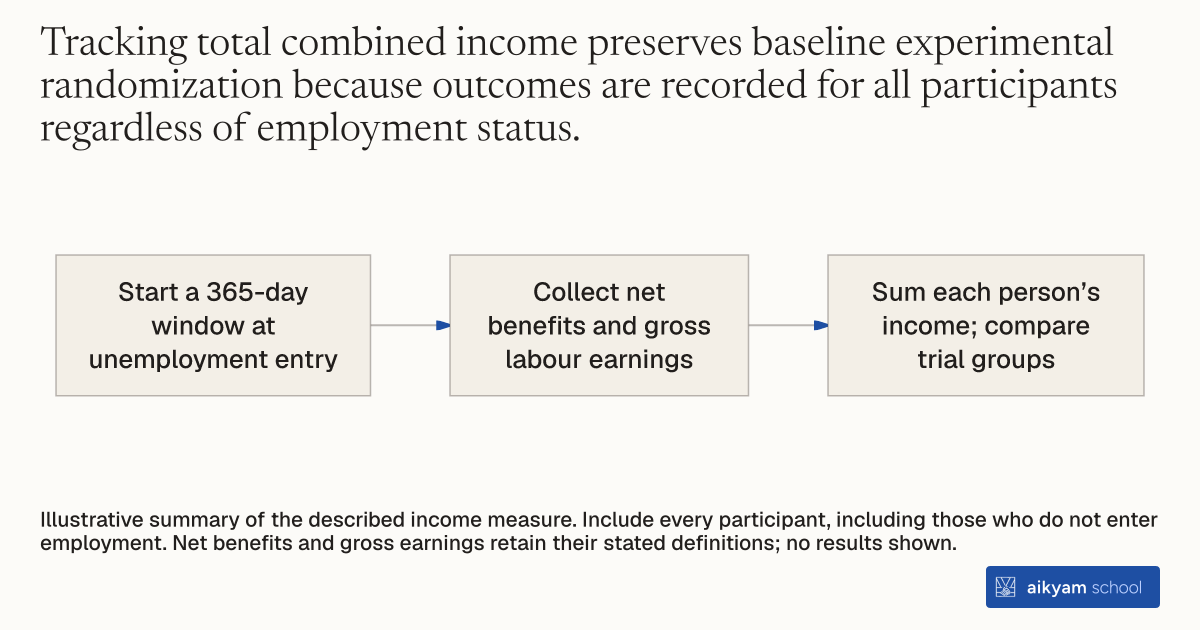
Research steps
Track income for every participant
- Start a 365-day window at unemployment entry
- Collect net benefits and gross labour earnings
- Sum each person’s income; compare trial groups
Illustrative summary of the described income measure. Include every participant, including those who do not enter employment. Net benefits and gross earnings retain their stated definitions; no results shown.
See source →How
When to use
Evaluating program impacts on accepted wages introduces sample selection bias because wages are observed only for individuals who find employment before the observation window ends. Unemployed workers who remain jobless contribute no wage observations, which distorts treatment effect comparisons across experimental arms. Tracking total cumulative income across a fixed timeframe combines benefit transfers and labor earnings for every participant.
Measure total post-entry income across a fixed calendar window by combining net unemployment insurance benefit transfers with labor earnings for all program participants.
- Define a fixed calendar tracking window starting on the first day of entry into unemployment insurance.
- Extract daily net unemployment insurance benefit payment records for every participant throughout the window.
- Extract daily gross labor earnings from social security registers for all participants who transition into employment.
- Sum the unemployment benefits and labor earnings for each individual over the designated tracking period.
- Compare mean cumulative income across treatment groups to assess total participant financial outcomes without right-censoring bias.
Why it works
This prevents sample selection bias caused by evaluating wages only among individuals who exit unemployment.
Example
In Germany, researchers evaluated financial outcomes for 4,163 unemployed men across 12 months. Instead of restricting analysis to accepted wages of employed workers, they calculated cumulative 365-day income by adding net unemployment insurance benefit transfers to active labor earnings for every participant in the trial.
About the study
Participants
4,163 male unemployment insurance benefit recipients aged 25 to 64 across five regional employment agencies in Germany.
Study Design
Methodological trial design evaluating total 365-day cumulative income (combining net unemployment benefits and labor earnings) using administrative social security registers.
Results
Tracking uncensored cumulative income across all 4,163 randomized participants provided an unbiased financial impact measure, confirming that early integration agreements increased 1-year re-employment from 45% to 53% for low-employability workers without causing negative wage or income distortion.