Research steps
Follow up baseline respondents after one year
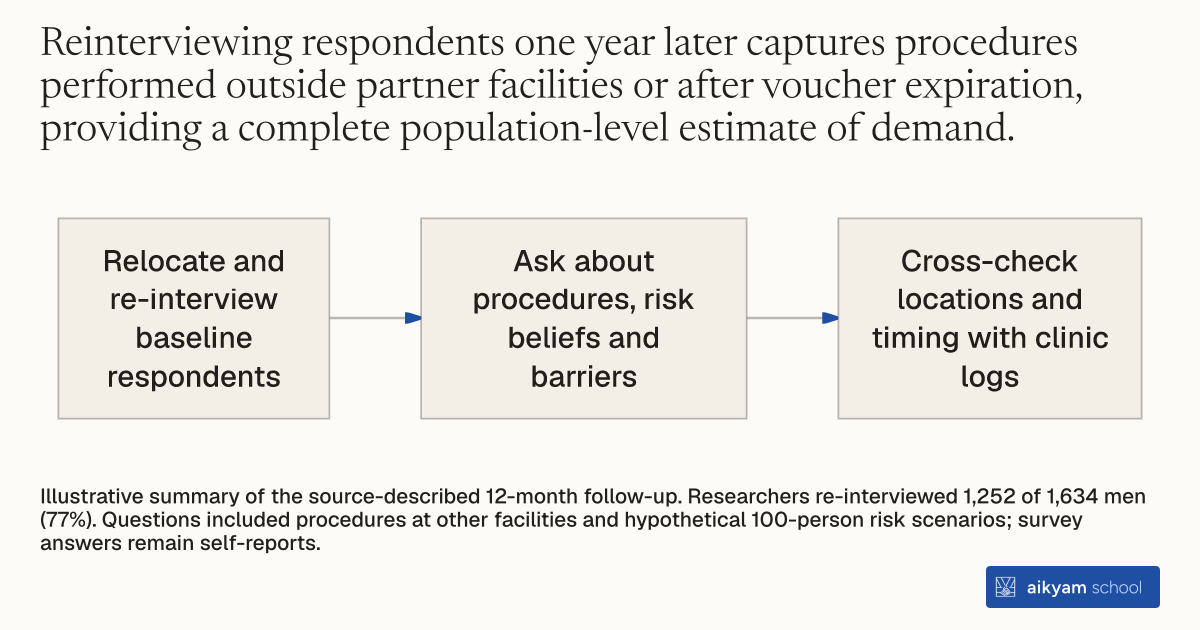
- Relocate and re-interview baseline respondents
- Ask about procedures, risk beliefs and barriers
- Cross-check locations and timing with clinic logs
Illustrative summary of the source-described 12-month follow-up. Researchers re-interviewed 1,252 of 1,634 men (77%). Questions included procedures at other facilities and hypothetical 100-person risk scenarios; survey answers remain self-reports.
See source →How
When to use
In longitudinal health evaluations, clinic administrative logs can miss off-site interventions or unrecorded visits, while self-reports may suffer from recall bias. Researchers need a systematic follow-up method to reinterview original baseline respondents and verify long-term behavioral and belief changes. This method uses a structured panel survey conducted one year post-baseline to measure overall service adoption and belief updating.
Re-interview baseline respondents one year after intervention to track self-reported circumcisions, non-partner clinic usage, and persistent changes in health beliefs.
- Deploy field enumerators to relocate original baseline survey respondents in their households approximately 12 months after the baseline interview.
- Administer a structured follow-up survey measuring self-reported circumcision status, partner clinic interactions, and procedures performed at non-partner clinics or traditional facilities.
- Re-examine subjective HIV transmission risk beliefs using hypothetical 100-person scenario questions to test long-term belief updating.
- Assess persistent structural and psychological barriers among non-circumcised respondents, including fear of pain, cultural norms, and opportunity costs.
- Cross-check self-reported circumcision locations and timing against physical clinic administrative voucher logs to identify discrepancies.
Why it works
Structured belief elicitation tests whether educational interventions create lasting cognitive updates regarding medical risk reduction.
Example
Enumerators reinterviewed 1,252 out of 1,634 baseline participants (77 percent follow-up rate) in Lilongwe, Malawi one year after baseline, revealing that overall circumcision take-up across all facilities was 8.9 percent compared to 3.3 percent in clinic records alone.
About the study
Participants
1,252 adult uncircumcised men re-interviewed out of 1,634 baseline participants in Lilongwe, Malawi.
Study Design
12-month panel follow-up survey evaluating self-reported circumcision, external facility usage, and risk belief retention.
Results
Achieved a 77 percent follow-up rate (1,252 men); overall circumcision take-up across clinic and survey data was 8.9 percent, while 26.0 percent had some interaction with the partner clinic.