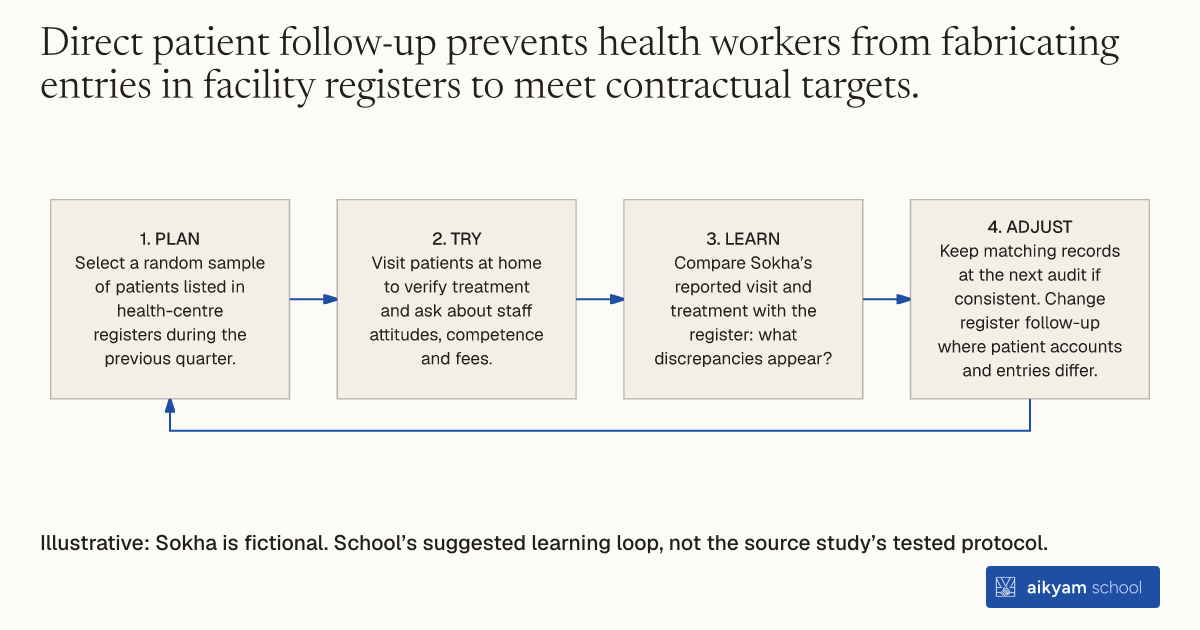
Try, learn and adjust
Check recorded treatment against patient accounts
- Plan: Select a random sample of patients listed in health-centre registers during the previous quarter.
- Try: Visit patients at home to verify treatment and ask about staff attitudes, competence and fees.
- Learn: Compare Sokha’s reported visit and treatment with the register: what discrepancies appear?
- Adjust: Keep matching records at the next audit if consistent. Change register follow-up where patient accounts and entries differ.
Illustrative: Sokha is fictional. School’s suggested learning loop, not the source study’s tested protocol.
See source →School’s suggested, untested loop. Observe treatment confirmation, patient experience and register discrepancies; this check does not establish clinical effectiveness.
How
When to use
Health management contracts risk ghost patients, padded registers, or false reporting when health workers face performance incentives. Routine administrative reporting without independent verification allows facilities to claim unearned bonus payments or hide non-attendance. Conduct patient register audits and direct patient follow-up visits to verify clinical service delivery.
Audit health center treatment registers by visiting listed patients at home to verify received care.
- Deploy independent monitoring teams to inspect medical logbooks and patient registers at rural health centers.
- Select a random sample of patient names and home addresses recorded in facility registers during the prior quarter.
- Travel directly to the sample villages to locate the listed patients or their family members.
- Interview the sampled patients to verify whether they visited the health center and received the recorded treatment.
- Record patient perceptions regarding staff polite attitudes, technical competence, and charged fees during the visit.
- Compare patient interview responses against administrative facility logs to check register accuracy and identify discrepancies.
Why it works
Knowing that patient registers are subject to home visits deters false record-keeping and holds providers accountable for actual patient care.
Example
In rural Cambodia, Ministry of Health monitoring teams conducted quarterly audits across five contracted health districts between 1999 and 2003. Auditors inspected health center registers and visited a sample of listed patients in their home villages to verify actual treatment. Register auditing across 143 health centers verified patient care without statistically significant falsification.
About the study
Participants
12 rural health districts across Takeo, Prey Veng, and Kampong Cham provinces in Cambodia, covering 1.26 million residents across 360 sample villages with 3,700 households and 143 health centers.
Study Design
Cluster-randomized trial evaluating 12 districts randomly assigned to contracting out, contracting in, or comparison status, using initial random eligibility as an instrumental variable for actual contract rollout.
Results
Register auditing across 143 health centers verified listed treatments, while contracting out improved overall facility management by 1.128 standard deviations and contracting in improved overall management by 0.599 standard deviations.