Research returns
Analyse official election records
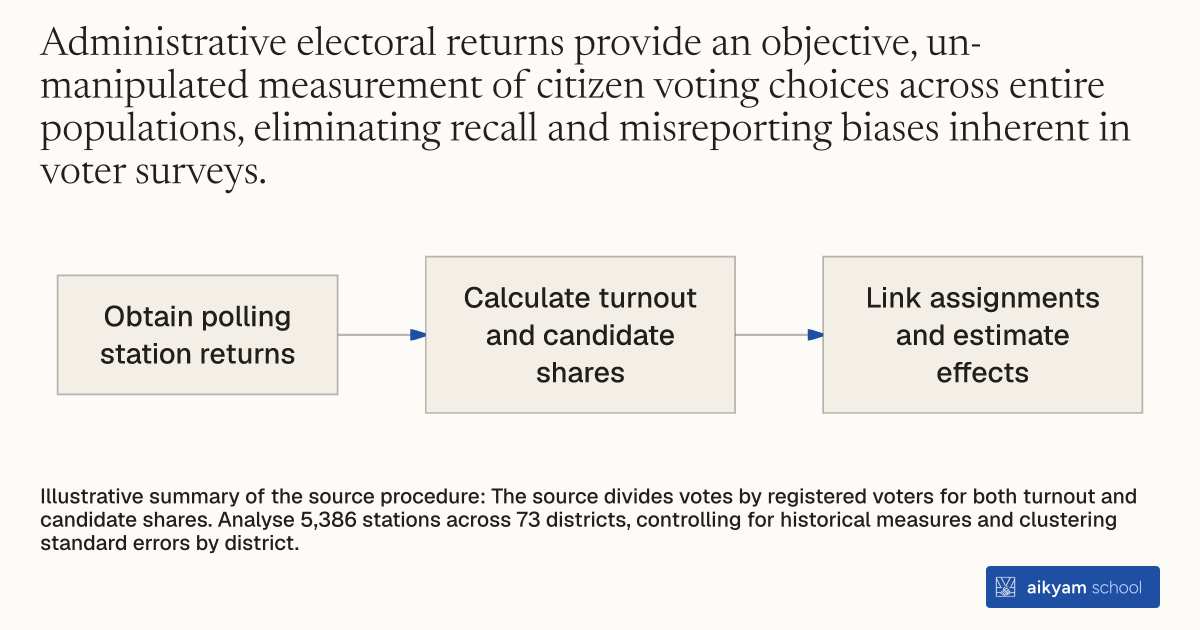
- Obtain polling station returns
- Calculate turnout and candidate shares
- Link assignments and estimate effects
Illustrative summary of the source procedure: The source divides votes by registered voters for both turnout and candidate shares. Analyse 5,386 stations across 73 districts, controlling for historical measures and clustering standard errors by district.
See source →How
When to use
In political economy trials, relying solely on self-reported survey responses to measure voting behavior can introduce social desirability bias or misreporting. Researchers and evaluators need an objective administrative measure to verify whether public informational interventions alter actual electoral choices and voter turnout. This method analyzes official polling station-level electoral returns to evaluate treatment effects on vote shares and voter participation.
Analyze administrative polling station electoral returns to evaluate programmatic treatment effects on voter turnout and candidate vote shares.
- Obtain official administrative polling station returns from the national election authority following an election.
- Calculate polling station voter turnout by dividing total votes cast for legislative candidates by the total registered voters at each polling station.
- Compute official vote shares for each candidate over the total registered voters at each polling station.
- Merge polling station data with district treatment assignments, controlling for historical polling station covariates like past turnout and baseline registration counts.
- Estimate OLS regressions of candidate vote shares and overall turnout on treatment assignment, clustering standard errors at the electoral district level.
Example
Researchers analyzed polling station electoral returns across 5,386 polling stations in all 73 districts of Liberia following the October 2017 legislative elections. The analysis demonstrated that high-intensity debate invitation increased overall polling station turnout by 1.5 percentage points and increased incumbent candidate vote share by 4.2 percentage points.
About the study
Participants
5,386 polling stations across all 73 electoral districts in Liberia during the October 2017 House of Representatives election.
Study Design
OLS regression analysis of official polling station electoral returns from the National Elections Commission, pre-stratified across 19 randomization blocks with district-clustered standard errors.
Results
Official voter turnout increased by 1.5 percentage points at treated polling stations (from 70.1 percent in control); incumbent vote share increased by 4.2 percentage points in treated districts; predicted challenger vote share decreased by 2.9 percentage points in treated districts.