Try, learn and adjust
Check servicing against machine downtime
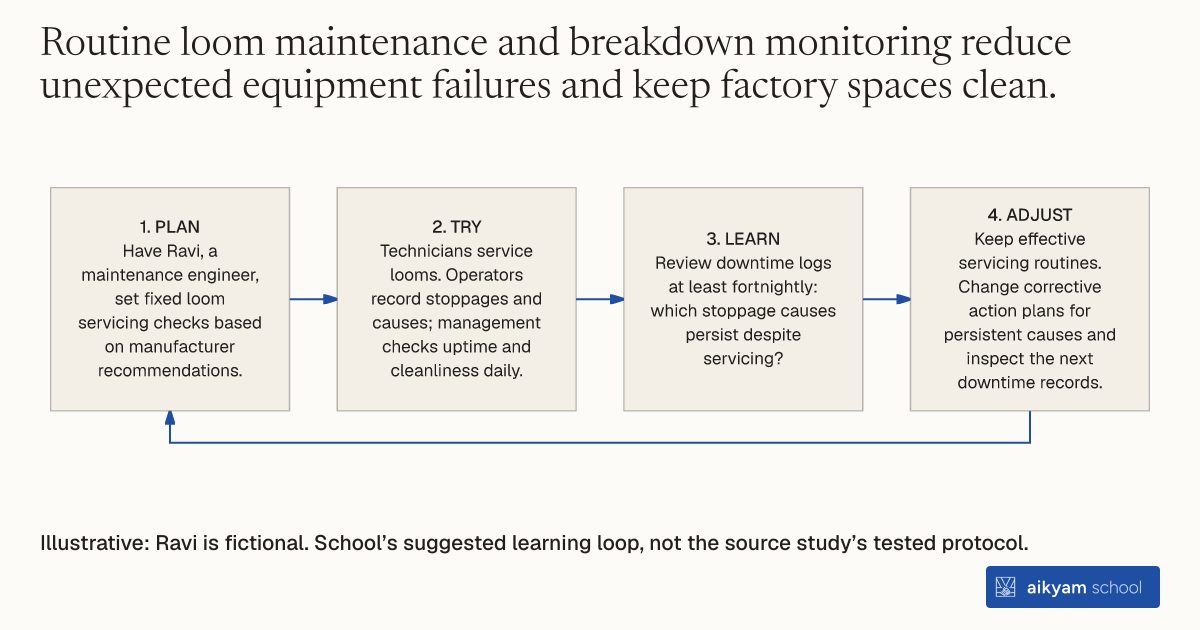
- Plan: Have Ravi, a maintenance engineer, set fixed loom servicing checks based on manufacturer recommendations.
- Try: Technicians service looms. Operators record stoppages and causes; management checks uptime and cleanliness daily.
- Learn: Review downtime logs at least fortnightly: which stoppage causes persist despite servicing?
- Adjust: Keep effective servicing routines. Change corrective action plans for persistent causes and inspect the next downtime records.
Illustrative: Ravi is fictional. School’s suggested learning loop, not the source study’s tested protocol.
See source →School’s suggested, untested loop: observe scheduled servicing, stoppage causes and uptime; no reduction in breakdowns is assumed.
How
When to use
Manufacturing facilities often operate equipment until it breaks down, causing unplanned stoppages, fabric defects, and excessive repair labor. A preventive machine maintenance program establishes scheduled servicing routines based on manufacturer guidelines and regular loom maintenance. This method helps plant managers reduce machine downtime and maintain steady production output.
Establish a systematic preventive machine maintenance schedule to perform routine servicing on all production looms before mechanical failures occur.
- Floor mechanics conduct routine preventive maintenance checks across all active weaving looms on a fixed schedule.
- Plant technicians perform machine servicing following manufacturer operational recommendations to prevent component wear and tear.
- Machine operators record every machine downtime incident and track specific stoppage causes on daily floor logs.
- Maintenance engineers review downtime logs at least fortnightly to implement targeted corrective action plans.
- Production management monitors machine uptime daily to evaluate loom performance and maintain factory cleanliness.
Why it works
This decreases production downtime and eliminates fabric quality defects caused by malfunctioning machinery.
Example
Between 2008 and 2017, international consultants introduced preventive machine maintenance across Indian weaving plants near Mumbai, increasing adoption from 40% in 2008 to 95% in 2017, with zero adopting plants dropping the practice after adoption.
About the study
Participants
28 manufacturing plants across 17 family-owned cotton weaving firms near Mumbai, India, averaging 270 employees, \$8.5 million in assets, and \$7.5 million in annual sales.
Study Design
Randomized Controlled Trial (RCT) tracking 38 management practices across treatment and control plants from 2008 to 2017.
Results
Preventive machine maintenance adoption rose from 40% in 2008 to 70% in 2011 and reached 95% in 2017, while output increased by 9.4% and Total Factor Productivity rose by 16.6% in treated plants.