Research design
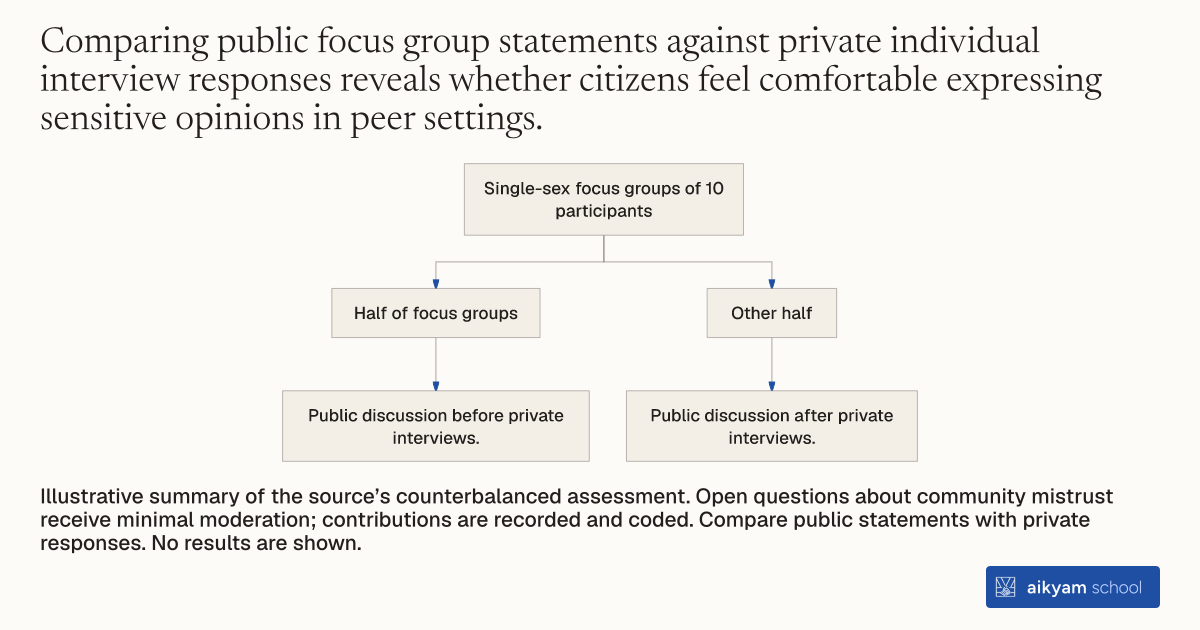
Counterbalance public and private interviews
Single-sex focus groups of 10 participants
- Half of focus groups
- Public discussion before private interviews.
- Other half
- Public discussion after private interviews.
Illustrative summary of the source’s counterbalanced assessment. Open questions about community mistrust receive minimal moderation; contributions are recorded and coded. Compare public statements with private responses. No results are shown.
See source →How
When to use
Evaluating willingness to speak out against social norms in post-conflict societies requires observing public group dynamics alongside private survey measures. In contexts where social desirability and state pressure discourage expressing sensitive truths, private interviews alone fail to reveal whether citizens feel empowered to dissent publicly. Public single-sex focus group deliberations measure whether participants will express controversial realities before their peers.
Convene single-sex participant groups for semi-structured public deliberations to measure public expression of controversial community topics.
- Divide sampled community members into single-sex groups of 10 participants per session.
- Counterbalance session timing by conducting half of the focus groups before private individual interviews and half after.
- Pose open-ended discussion questions on sensitive community issues, such as whether mistrust exists in their village.
- Maintain minimal researcher moderation so the session functions as a peer community forum rather than a question-and-answer period.
- Record participant contributions and code whether comments publicly confirm or deny controversial local realities.
Why it works
Minimizing researcher moderation allows group norms to guide participant interactions and public speech.
Example
In post-genocide Rwanda, researchers conducted single-sex focus groups of 10 participants across eight research sites following a year-long radio intervention to discuss whether mistrust existed in their community. While 80% of participants across both trial arms privately acknowledged community mistrust in individual interviews, over 60% of health group comments publicly denied mistrust compared to fewer than 20% among reconciliation drama listeners.
About the study
Participants
278 participants in single-sex groups of 10 across 8 research sites in Rwanda (prisons, survivor communities, and general population villages).
Study Design
Posttest field experiment focus group evaluation counterbalancing pre- and post-interview group timing across treatment and comparison communities, analyzing public comment content regarding community mistrust using regression models with cluster standard errors.
Results
Reconciliation drama listeners showed significantly fewer public denials of community mistrust than health drama listeners (fewer than 20% vs over 60% of comments, beta = 0.96, se = 0.37, p < 0.01; 7% vs 39% unqualified denials), demonstrating an increased public willingness to speak out on sensitive community problems without altering average speaking time per question (beta = -4.96, se = 3.59, p = .22).