Research procedure
Use visual response scales in private
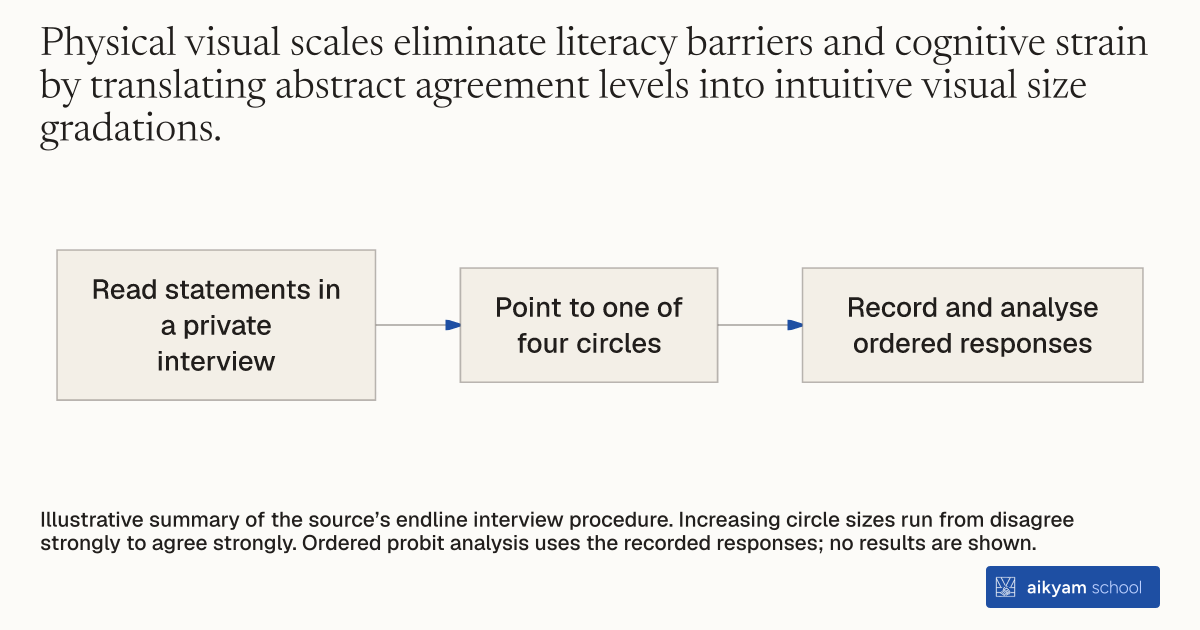
- Read statements in a private interview
- Point to one of four circles
- Record and analyse ordered responses
Illustrative summary of the source’s endline interview procedure. Increasing circle sizes run from disagree strongly to agree strongly. Ordered probit analysis uses the recorded responses; no results are shown.
See source →How
When to use
Measuring individual attitudes and social norms in low-literacy or rural post-conflict settings presents significant survey design challenges. Abstract numerical Likert scales often confuse respondents who lack formal schooling or experience with standardized questionnaires. Presenting physical visual response cards enables participants to express nuanced degrees of agreement accurately and privately.
Administer structured individual endline questionnaires using physical visual scale cards to quantify participant attitudes, norm perceptions, and social distance.
- Deploy trained local enumerators to conduct private face-to-face interviews with each study participant at the end of the intervention period.
- Hand each participant a large index card printed with four progressively larger circles representing ordered response levels from disagree strongly to agree strongly.
- Read each survey statement aloud in the local language, including items on prescriptive norms of dissent, community mistrust, and social distance.
- Instruct participants to indicate their response by physically pointing to one of the four printed circles on the index card.
- Record responses on standardized answer sheets and analyze the ordered categorical outcomes using ordered probit regression models.
Why it works
Conducting interviews individually in private prevents peer pressure and social desirability bias from distorting reported personal beliefs.
Example
At the end of the one-year study across 14 sites in Rwanda, 17 researchers conducted private individual interviews with 556 participants, using four-circle index cards to measure norms of dissent, private community mistrust, and cross-group social distance.
About the study
Participants
556 participants across 14 community clusters in Rwanda (50% male, average age 38.9 years, 79% farmers, 69-73% with primary schooling).
Study Design
Individual posttest survey administered privately across 14 clusters following a year-long cluster-randomized radio trial, utilizing a 4-point visual circle scale and analyzed using ordered probit regression with robust cluster standard errors and baseline pretest covariates.
Results
Reconciliation listeners showed a statistically significant increase in perceived norm of dissent compared to health listeners (0.26 to 0.29 probit shift, p < 0.001; site-level linear model beta = 1.70, se = 0.63, p < 0.05), shifting a baseline 30% probability of strong agreement up to 40%, while 80% of participants across both arms privately acknowledged community mistrust.