Research procedure
Sample caregivers across a village
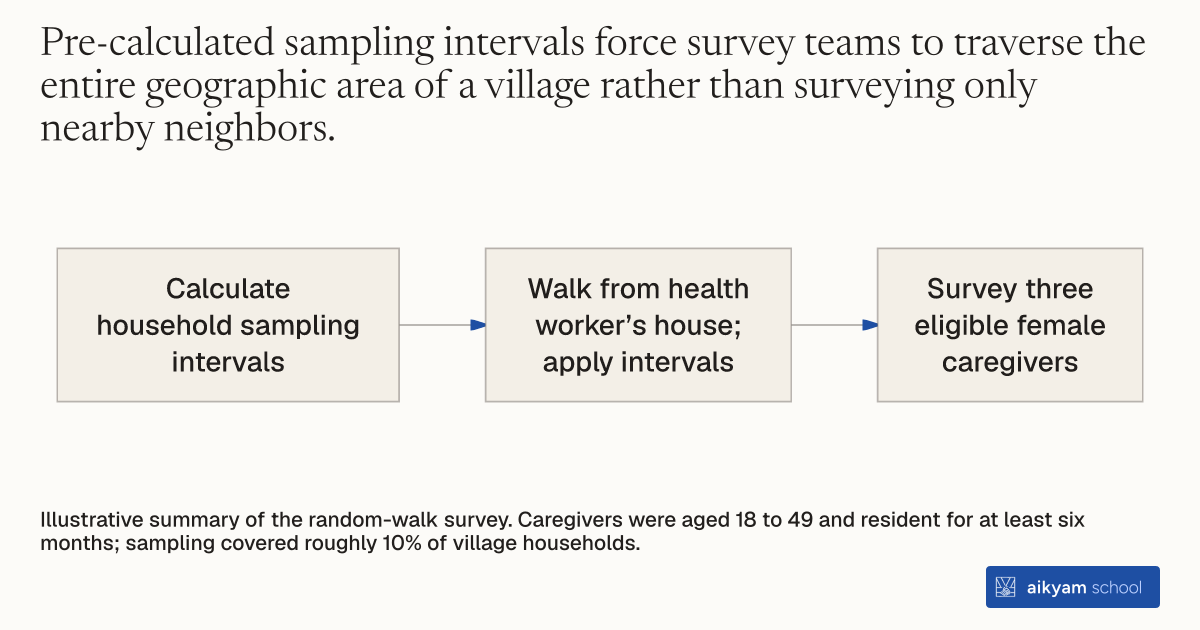
- Calculate household sampling intervals
- Walk from health worker’s house; apply intervals
- Survey three eligible female caregivers
Illustrative summary of the random-walk survey. Caregivers were aged 18 to 49 and resident for at least six months; sampling covered roughly 10% of village households.
See source →How
When to use
Evaluating rural health programs requires representative community survey data when official household rosters do not exist. Selecting households close to health worker homes introduces proximity bias and overestimates service delivery coverage. A random walk sampling protocol across pre-specified household intervals ensures representative community data collection.
Sample rural community households representatively without pre-existing population lists using a structured random walk protocol.
- Determine the total estimated household count for each target village community.
- Calculate pre-specified sampling step intervals based on total village household count to ensure community-wide coverage.
- Begin the sampling walk directly from the designated community health worker's house.
- Advance through the village along the walking route, skipping the calculated interval number of houses between selections.
- Identify primary female caregivers aged 18 to 49 who resided in selected households for at least six months.
- Survey three eligible household caregivers per village, representing roughly 10% of village households.
Why it works
Targeting primary female caregivers ensures data collection from the individuals most knowledgeable about maternal and child health visits.
Example
In Sierra Leone, survey enumerators conducted random walk sampling across villages in 372 peripheral health unit catchment areas. Starting at each community health worker's home, enumerators applied pre-calculated interval steps to sample three primary female caregivers per village, surveying 1,966 households representing 10% of the community.
About the study
Participants
1,966 primary female caregivers aged 18 to 49 residing in villages across 372 Peripheral Health Units in Sierra Leone.
Study Design
Endline random walk household survey sampling 10% of community households to measure health worker visit frequency and visit duration.
Results
Random walk sampling successfully gathered representative performance data showing control CHWs provided an average of 6.749 household visits lasting 11.99 minutes, while meritocratic incentives increased visits by 22% (+1.497 visits).