Try, learn and adjust
Check staff attendance under the district’s practice rules
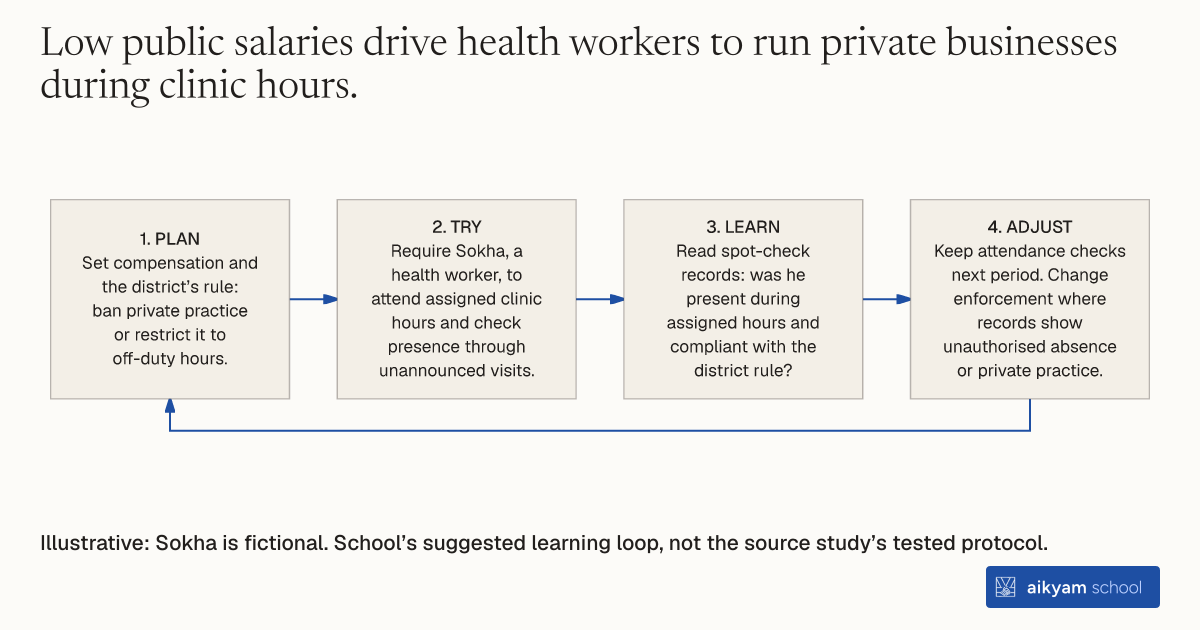
- Plan: Set compensation and the district’s rule: ban private practice or restrict it to off-duty hours.
- Try: Require Sokha, a health worker, to attend assigned clinic hours and check presence through unannounced visits.
- Learn: Read spot-check records: was he present during assigned hours and compliant with the district rule?
- Adjust: Keep attendance checks next period. Change enforcement where records show unauthorised absence or private practice.
Illustrative: Sokha is fictional. School’s suggested learning loop, not the source study’s tested protocol.
See source →School’s suggested, untested loop. Observe compensation, attendance and the applicable rule. Two treated districts attempted bans; three restricted private work through assigned-hour attendance.
How
When to use
Public health workers in developing countries often run private practices on the side to supplement low government salaries. This practice causes high absenteeism at public clinics, patient diversion, and unauthorized under-the-table charges. Restrict or prohibit off-duty private practice while raising public compensation to keep health staff present and focused on public health delivery.
Restrict or ban private practice among public clinic employees to enforce full-time attendance at assigned government health facilities.
- Offer higher fixed salaries or performance-based salary supplements to offset lost private practice income.
- Mandate that public health staff remain present at government facilities throughout their assigned operational hours.
- Prohibit staff from operating private medical clinics or drug shops, or restrict private practice strictly to off-duty hours.
- Conduct unannounced spot checks to verify staff presence during scheduled clinic operating hours.
- Apply contractual sanctions, payment suspensions, or dismissal for health workers who engage in unauthorized private practice or absent themselves.
Why it works
Combining strict rules on private practice with higher compensation aligns staff financial incentives with full-time attendance at public facilities.
Example
In Cambodia, management contractors in five treated health districts restricted or banned private practice among government health personnel between 1999 and 2003. Two districts attempted full bans on private practice, while three restricted private work by enforcing mandatory health center attendance. This raised scheduled staff presence at health centers by 50 to 79 percentage points over comparison facilities.
About the study
Participants
12 rural health districts across Takeo, Prey Veng, and Kampong Cham provinces in Cambodia, covering 1.26 million residents across 360 sample villages with 3,700 households and 143 health centers.
Study Design
Cluster-randomized trial evaluating 12 districts randomly assigned to contracting out, contracting in, or comparison status, using initial random eligibility as an instrumental variable for actual contract rollout.
Results
Restricting or banning private practice combined with salary incentives increased scheduled staff presence by 50 percentage points in contracting-in districts and 79 percentage points in contracting-out districts, while reducing visits to private providers by 9 percentage points.