Try, learn and adjust
Check that shop-floor instructions stay visible
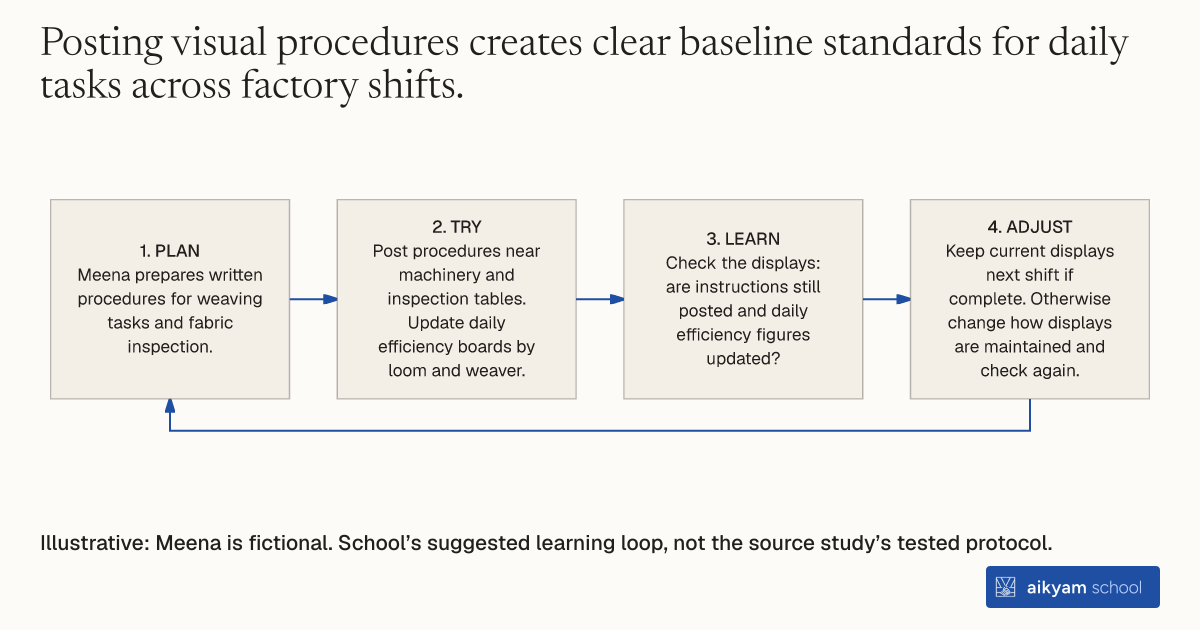
- Plan: Meena prepares written procedures for weaving tasks and fabric inspection.
- Try: Post procedures near machinery and inspection tables. Update daily efficiency boards by loom and weaver.
- Learn: Check the displays: are instructions still posted and daily efficiency figures updated?
- Adjust: Keep current displays next shift if complete. Otherwise change how displays are maintained and check again.
Illustrative: Meena is fictional. School’s suggested learning loop, not the source study’s tested protocol.
See source →Observe posted procedures and daily board updates. School suggests this learning loop; it is not the source’s tested procedure.
How
When to use
Manufacturing plants often operate with informal operational workflows that vary between workers. Displaying written standard operating procedures on the shop floor provides clear visual instructions for machine operation and quality checks. This helps factory managers standardize work steps for weavers, gaiters, and quality supervisors.
Display written operating procedures and visual tracking boards on factory walls to guide daily shop-floor tasks.
- Draft written standard operating procedures for core production tasks including warping, drawing, weaving, and beam gaiting.
- Post visible instruction sheets on factory walls directly next to production machinery and supervisor work stations.
- Display standard operating procedures for quality supervisors and checkers at fabric inspection tables.
- Mount visual display boards on the shop floor to show daily production efficiency by loom and weaver.
- Update visual efficiency boards daily to inform operators and managers of machine performance.
Why it works
Visual boards provide immediate feedback to machine operators and make operational performance visible to floor supervisors.
Example
In 2008, consultants introduced visual displays and written operating procedures across experimental textile plants in Mumbai, India. Written procedures for weaving tasks were displayed in 45% of plants by 2011, but 100% of adopting plants dropped these displayed signs by 2017 after external consulting ended.
About the study
Participants
28 manufacturing plants across 17 family-owned cotton weaving firms near Mumbai, India, averaging 270 employees, $8.5 million in assets, and $7.5 million in annual sales.
Study Design
Randomized Controlled Trial (RCT) tracking 38 management practices across treatment and control plants from 2008 to 2017.
Results
Displaying written warping, drawing, weaving, and beam gaiting procedures increased from 10% in 2008 to 45% in 2011 before dropping to 0% in 2017, with 100% of adopters dropping the practice.