Research procedure
Calculate net societal value
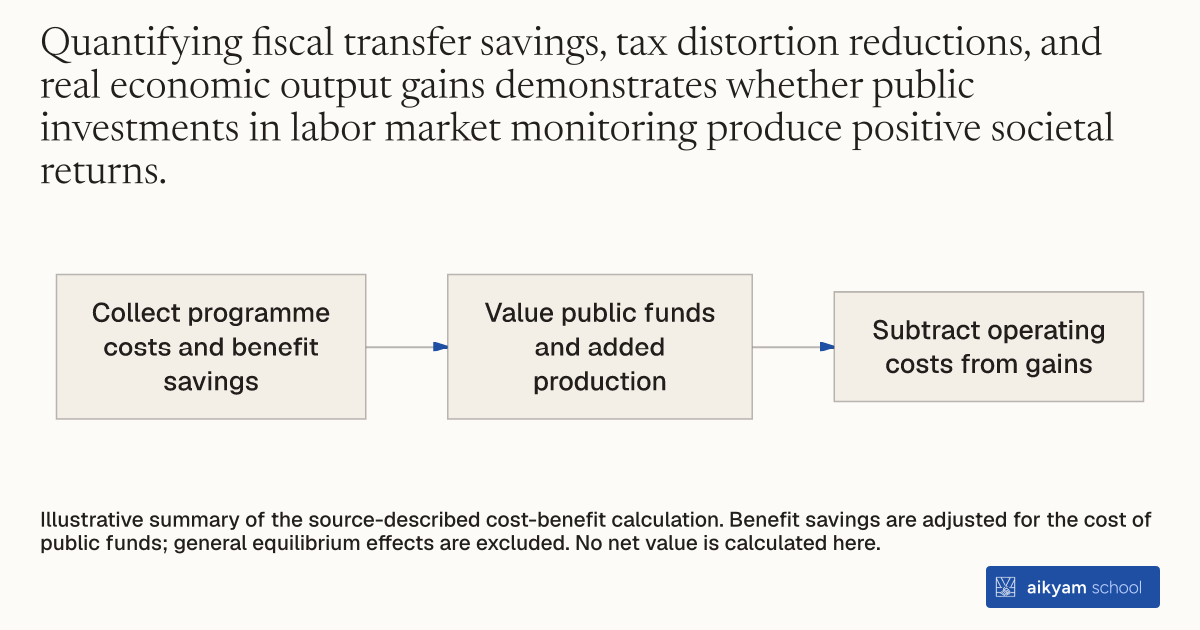
- Collect programme costs and benefit savings
- Value public funds and added production
- Subtract operating costs from gains
Illustrative summary of the source-described cost-benefit calculation. Benefit savings are adjusted for the cost of public funds; general equilibrium effects are excluded. No net value is calculated here.
See source →How
When to use
Active labor market policy interventions require significant operational expenditure for increased caseworker meetings and training courses. Conducting a societal cost-benefit analysis evaluates whether reduced unemployment benefit payouts and increased production value outweigh operational program costs. Economic policy evaluators use this method to calculate net social welfare gains for public employment programs.
Calculate net societal returns of an active labor market intervention by balancing administrative costs against fiscal and production gains.
- Gather detailed administrative cost data associated with delivering intensified counseling, meetings, and activation programs.
- Calculate reduced unemployment insurance benefit payouts resulting from shorter average unemployment durations.
- Multiply unemployment insurance savings by the price of providing public funds to account for tax distortion costs.
- Estimate increased economic production value resulting from workers returning to employment faster.
- Subtract total program operational costs from combined tax distortion savings and production value gains to determine net societal value.
Example
The Danish Economic Council evaluated the 2005–2006 Danish active labor market experiment using detailed cost records. They calculated reduced unemployment insurance benefit payments multiplied by the price of public funds alongside production gains, finding that the intensive regime produced a net value to society of €2,000 per unemployed worker.
About the study
Participants
N = 4,513 unemployed individuals across Storstrøm and Southern Jutland counties, Denmark.
Study Design
Cost-benefit economic evaluation based on randomized trial outcomes, calculating net welfare impact per participant while ignoring general equilibrium effects.
Results
The intensified labor policy regime generated a net societal value of €2,000 per exposed unemployed individual, demonstrating positive overall welfare returns.