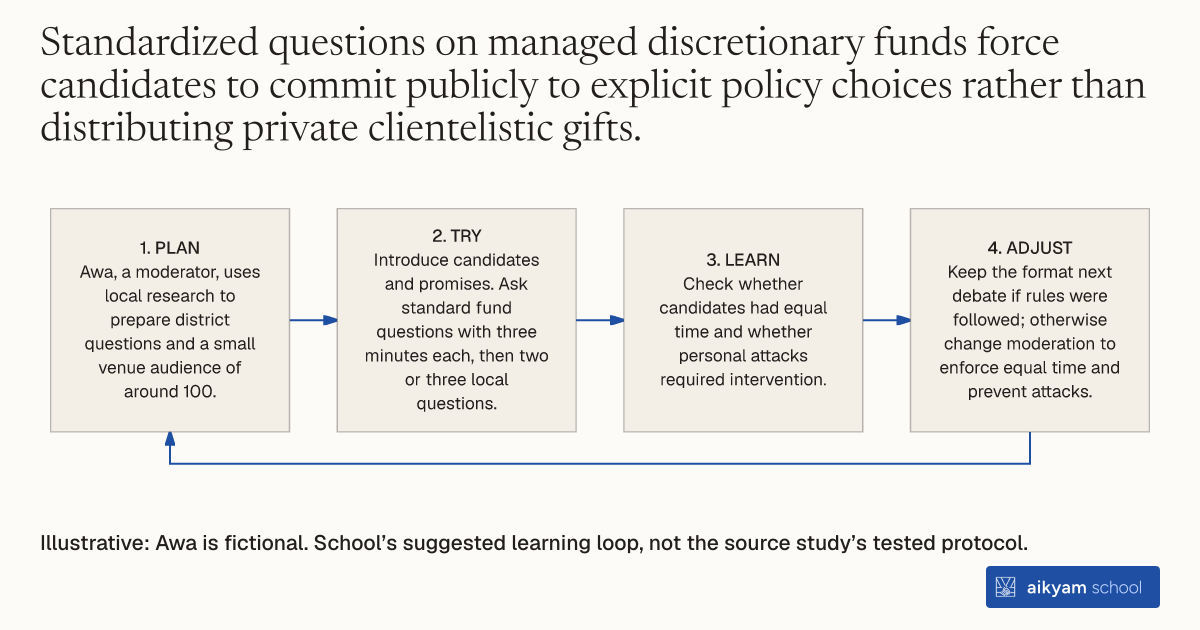
Try, learn and adjust
Check equal time and policy questions in debates
- Plan: Awa, a moderator, uses local research to prepare district questions and a small venue audience of around 100.
- Try: Introduce candidates and promises. Ask standard fund questions with three minutes each, then two or three local questions.
- Learn: Check whether candidates had equal time and whether personal attacks required intervention.
- Adjust: Keep the format next debate if rules were followed; otherwise change moderation to enforce equal time and prevent attacks.
Illustrative: Awa is fictional. School’s suggested learning loop, not the source study’s tested protocol.
See source →School’s suggested, untested learning loop. Observe speaking time, policy questions and personal attacks; this is not evidence of electoral effects.
How
When to use
In clientelistic electoral environments, candidates rarely articulate concrete policy platforms to voters and rely on private gift distribution. Organisers need a transparent, neutral public forum to elicit verifiable policy promises from parliamentary candidates. This method convenes local legislative candidates for a structured debate focused on public funds and district development issues.
Organise standardized electoral district candidate debates to elicit concrete policy promises using a structured moderating format.
- Local journalists conduct background research on local issues relevant to constituents in each electoral district.
- Debate organisers secure administrative buildings, town halls, or school venues and keep live audiences small at around 100 people to minimize safety and conflict risks.
- Debate moderators introduce participating candidates and allow each candidate to outline campaign policy promises.
- Moderators ask each candidate standard questions regarding the County Social Development Fund and discretionary Legislative Support Project funds, granting each candidate three minutes to respond.
- Moderators pose two or three questions on local district policy issues based on prior research.
- Moderators intervene whenever necessary to enforce equal time limits and strictly prevent candidates from launching personal attacks.
Why it works
Restricting personal attacks and enforcing strictly equal speaking time focuses citizen attention on comparing programmatic proposals.
Example
Internews and Liberian journalist associations hosted 129 standardized candidate debates across all 73 electoral districts in Liberia between mid-August and mid-September 2017. Participating candidates outlined campaign platforms and answered questions on discretionary funding and local issues before small live audiences of roughly 100 citizens.
About the study
Participants
73 electoral districts, 129 debates, and 984 legislative candidates across Liberia in August–September 2017.
Study Design
District-level randomized trial evaluating nationwide standardized candidate debates combined with randomized debate invitation intensity and radio rebroadcasting across 73 districts.
Results
Nationwide debate initiative led to 129 debates in all 73 districts with 59% candidate participation overall (48% of incumbents and 60% of challengers); citizen exposure to debate content increased by 0.304 standard deviations in high-intensity persuasion districts.