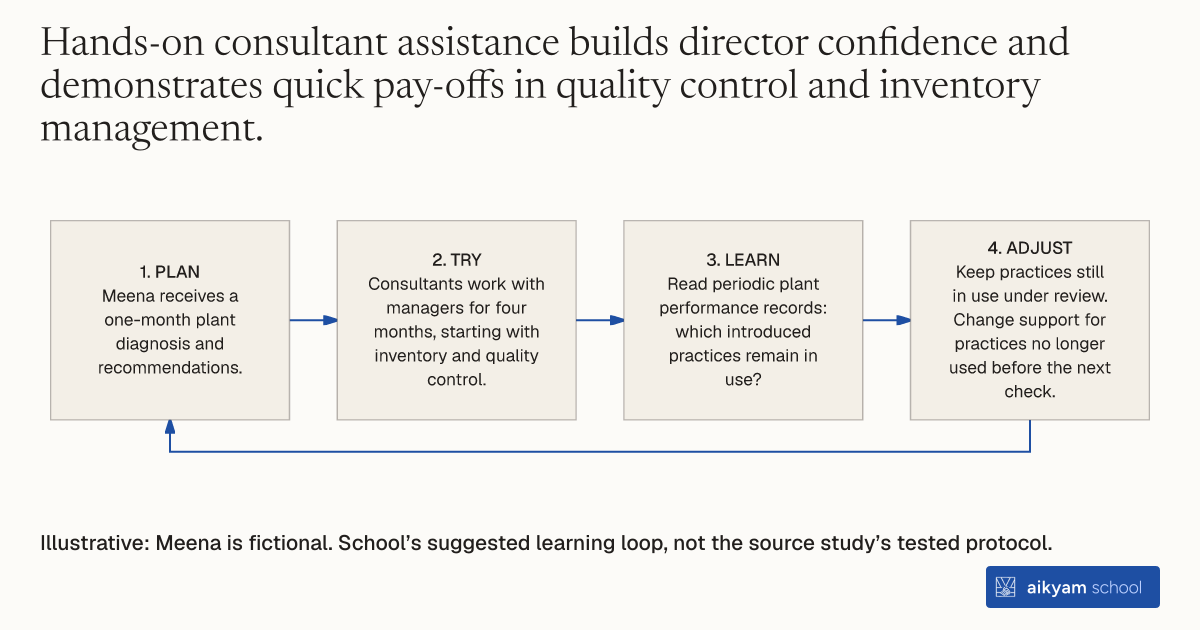
Try, learn and adjust
Check management practices after consulting support
- Plan: Meena receives a one-month plant diagnosis and recommendations.
- Try: Consultants work with managers for four months, starting with inventory and quality control.
- Learn: Read periodic plant performance records: which introduced practices remain in use?
- Adjust: Keep practices still in use under review. Change support for practices no longer used before the next check.
Illustrative: Meena is fictional. School’s suggested learning loop, not the source study’s tested protocol.
See source →Observe practice use and plant performance over time. School suggests this learning loop; it is not the source’s tested procedure.
How
When to use
Medium and large manufacturing firms in developing countries often operate with inefficient shop-floor routines and unmonitored defect rates. This intervention provides structured external consulting expertise to diagnose organizational weaknesses and embed standard operating practices. It helps plant managers and firm owners build reliable operational systems that persist over the long term.
Execute a structured three-phase consulting program to evaluate, implement, and track modern operational management practices across manufacturing facilities.
- Assign an external consulting team to spend one month evaluating baseline plant operations and compiling a performance database across five key operational areas.
- Deliver a detailed diagnostic report with tailored recommendations for practice improvements to firm directors and plant managers.
- Conduct a four-month intensive implementation phase where consultants work full-time alongside plant management to introduce, fine-tune, and stabilize targeted management practices.
- Pilot initial operational changes in low-risk factory areas like inventory and quality control before expanding into complex workflow routines.
- Provide ongoing light consulting advice and track plant performance metrics periodically over subsequent years to ensure practice persistence.
Why it works
Combining intensive initial implementation with long-term tracking allows operational routines to stabilize into lasting organizational habits.
Example
In 2008, an international consulting team worked with 14 experimental textile plants in multi-plant weaving firms near Mumbai, India. The consultants introduced 38 standard practices across operations, quality, inventory, human resources, and sales over four months, increasing practice adoption by 37.8 percentage points by 2010.
About the study
Participants
28 manufacturing plants across 17 family-owned cotton weaving firms near Mumbai, India, averaging 270 employees, $8.5 million in assets, and $7.5 million in annual sales.
Study Design
Randomized Controlled Trial (RCT) assigning plants to treatment and control groups across a 1-month diagnostic phase, 4-month implementation phase, and a 9-year follow-up panel from 2008 to 2017.
Results
Treatment experimental plants increased adoption of 38 target practices by 37.8 percentage points in August 2010 and maintained a statistically significant 19.7 percentage point treatment effect over control plants in 2017.